
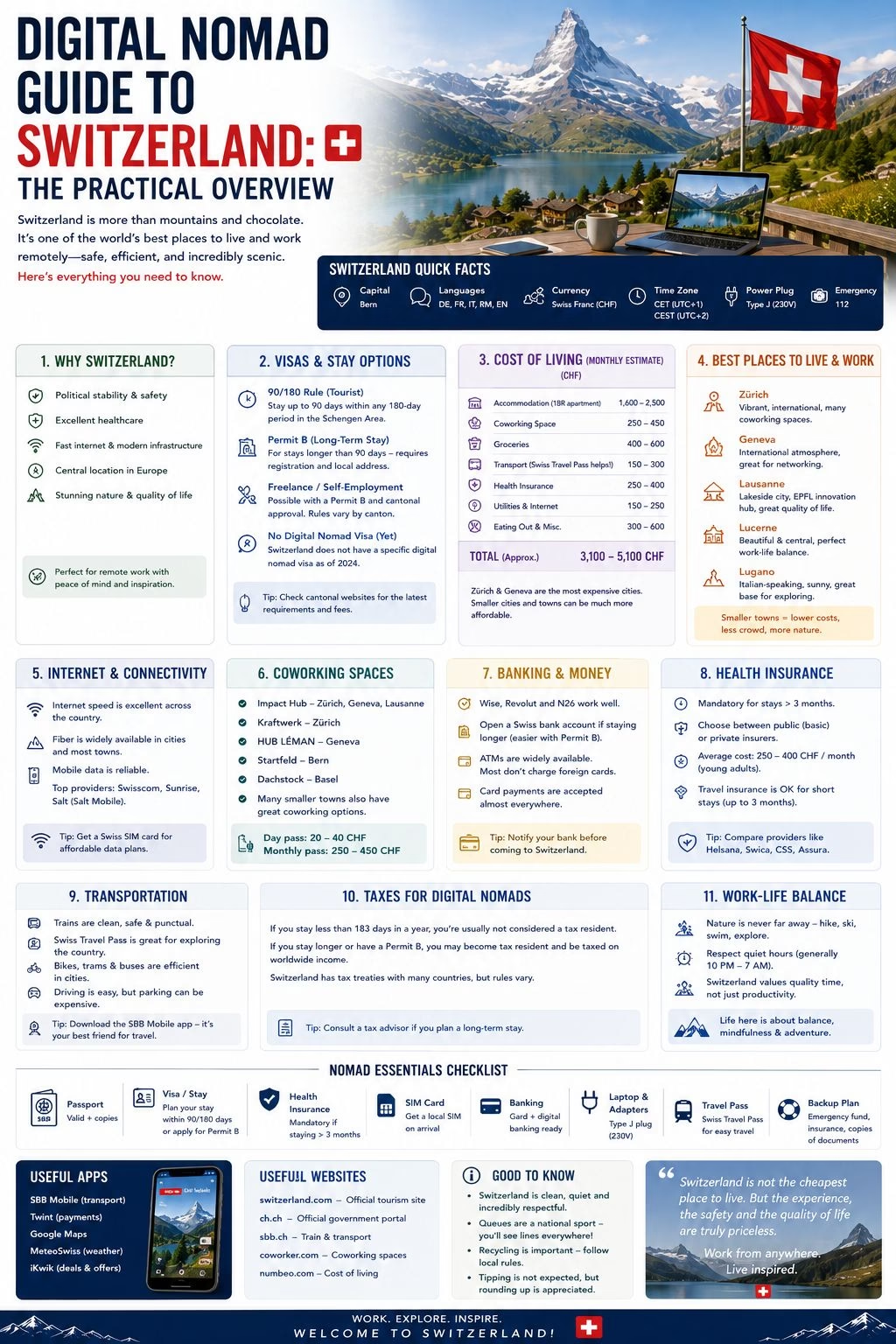
Switzerland is an appealing but legally awkward option for remote workers. The quality of life, infrastructure, and natural environment are exactly what the digital nomad lifestyle is supposed to deliver: reliable high-speed internet nearly everywhere, a train network that makes weekend mountain trips genuinely practical from any city base, and a level of day-to-day safety and predictability that’s hard to overstate until you’ve lived somewhere without it. But Switzerland does not have a dedicated digital nomad visa, which means the legal basis for a longer stay has to be built from the existing immigration framework rather than a purpose-made category, and that gap catches a lot of first-time researchers by surprise.
This guide covers the realistic options, who they actually work for, and the practical considerations (tax, banking, cost) that matter regardless of which legal path applies. It’s a starting point rather than a substitute for professional immigration advice on a specific case, which is genuinely worth paying for if your situation isn’t the straightforward EU/EEA case.
The Legal Reality: No Dedicated Nomad Visa
Unlike Portugal, Spain, Croatia, and several other European countries that have introduced specific digital nomad visas in recent years, Switzerland has not, and there’s no strong public signal that one is imminent. This means the options for a remote worker wanting to be in Switzerland longer than a short visit fall back on the existing categories: visa-free Schengen tourism for EU/EEA and many other nationalities (up to 90 days in any 180-day period, covered in full in the Visa and Entry Requirements guide), the free movement rights available specifically to EU/EEA citizens, or a standard residence permit obtained through employment, self-employment registration, or financial independence for those who qualify.
In practice, this means most remote workers treat Switzerland as a base for stays within the 90-day Schengen allowance rather than attempting to establish formal long-term residence purely on the strength of remote income for a foreign employer. The legal path for that specific situation (working remotely for a non-Swiss company while resident in Switzerland long-term, without a Swiss employer or Swiss self-employment registration) is genuinely unclear and under-tested for non-EU/EEA nationals specifically, and immigration lawyers tend to be cautious rather than confident when asked about it directly.
Who This Actually Works For
EU/EEA citizens have by far the simplest path: free movement rights allow living and working in Switzerland, including remote work for foreign employers, without needing to justify the arrangement through a specific visa category. The same Residence Permits process that applies to any EU/EEA citizen moving to Switzerland applies here too. For an EU/EEA citizen, remote work for a foreign employer while resident in Switzerland is a genuinely normal, well-trodden arrangement, though it does raise employer-side questions around payroll and social security that are worth the employer resolving properly rather than ignoring.
Non-EU/EEA remote workers have a narrower set of realistic options: short Schengen-compliant stays (90 days, then required to leave the Schengen area before returning, which some remote workers structure as a rotation between Switzerland and a non-Schengen base), a self-employment residence permit if the remote work can be formally structured as a Swiss-registered independent activity (a genuinely involved process, canton-dependent, and not guaranteed, since cantons assess these applications on the economic interest they bring to the canton, and a straightforward remote-work arrangement doesn’t always meet that bar), or qualifying for one of the standard employment-based or financially-independent-resident permit categories on grounds unrelated to the remote work itself.
A Fourth Option: Lump-Sum Taxation Residency
Beyond employment, self-employment, and family-based routes, Switzerland also offers a residency path for financially independent individuals not engaging in gainful employment in Switzerland, sometimes referred to informally as a “Golden Visa” route, though Switzerland does not use that term officially. This is the lump-sum taxation (forfait fiscal) arrangement: rather than proving a specific investment amount, applicants agree to be taxed on an assessed expenditure basis rather than on actual worldwide income. The tax is not a fixed fee: the federal minimum taxable base is currently CHF 434,700, cantons can set higher minimums, and the amount is typically agreed case by case with the canton. The taxable base cannot be lower than your actual annual living costs (in Switzerland and abroad), the minimum for the canton, or at least seven times your annual rent or rental value, and the ordinary tax rates are then applied to it. In practice the resulting tax is often quoted in the low to mid six figures a year, so the specific number depends heavily on where you choose to live. The route is open to foreign nationals (Swiss citizens are excluded) who are moving to Switzerland for the first time or returning after at least ten years abroad, and who do not carry out gainful activity in Switzerland. EU/EFTA nationals can use it, while non-EU/EFTA nationals face stricter permit conditions and more cantonal discretion. Five cantons (Zurich, Basel-Stadt, Basel-Landschaft, Schaffhausen, and Appenzell Ausserrhoden) have abolished it, so it depends on where you settle. It is not a route for working nomads: the regime exists for people who do not work in Switzerland, so it needs specialist tax and immigration advice rather than general planning.
Practical Considerations Beyond the Visa Question
Tax residency is a separate and important issue from immigration status, and it’s one of the most commonly misunderstood parts of the whole picture. Under Swiss tax law, a stay of at least 30 days while carrying out gainful activity, or at least 90 days without gainful activity, can make you a Swiss tax resident, whatever your visa category or Schengen compliance, with implications for both Swiss tax obligations and the tax treatment in your home country. Remote work done while you are physically in Switzerland is likely to count as gainful activity, so the shorter 30-day threshold may apply to a nomad rather than the 90-day one. This is genuinely worth professional advice rather than assumption. A cross-border tax advisor familiar with both jurisdictions is a reasonable investment before committing to an extended Switzerland-based remote work arrangement.
Banking as a non-resident or short-stay visitor is more difficult than banking as a registered resident. Opening a standard Swiss bank account typically requires proof of registered address (the Anmeldung process covered in the Living in Zürich guide), which isn’t available to short-stay visitors without a permit. Many remote workers on short Schengen stays rely on international banking apps (Wise, Revolut, and similar) rather than a Swiss account, which works reasonably well for day-to-day spending but doesn’t solve every problem: some Swiss landlords and services still expect a Swiss IBAN specifically.
Cost is the other major factor, and it shouldn’t be an afterthought: Switzerland has some of the highest consumer prices in the world, and a remote-work stay needs to be budgeted accordingly rather than assumed to be roughly similar to wherever you’re coming from. The full breakdown is in the Cost of Living guide.
A Realistic Way to Think About It
For most non-EU/EEA remote workers, the honest, low-risk version of a Switzerland digital nomad experience is a series of shorter stays within the Schengen 90-day allowance, treating Switzerland as one stop in a broader European base rather than attempting single continuous long-term residence without a clear permit basis. For EU/EEA citizens, the calculation is entirely different and considerably more open: the main constraints become cost and finding suitable accommodation rather than any immigration barrier.
Related: Residence Permits | Cost of Living | Best Cities for Digital Nomads | Visa and Entry Requirements
Written by Laura Meier. Updated regularly as prices and conditions change. Corrections and updates are welcome at contact@allaboutswiss.com.