
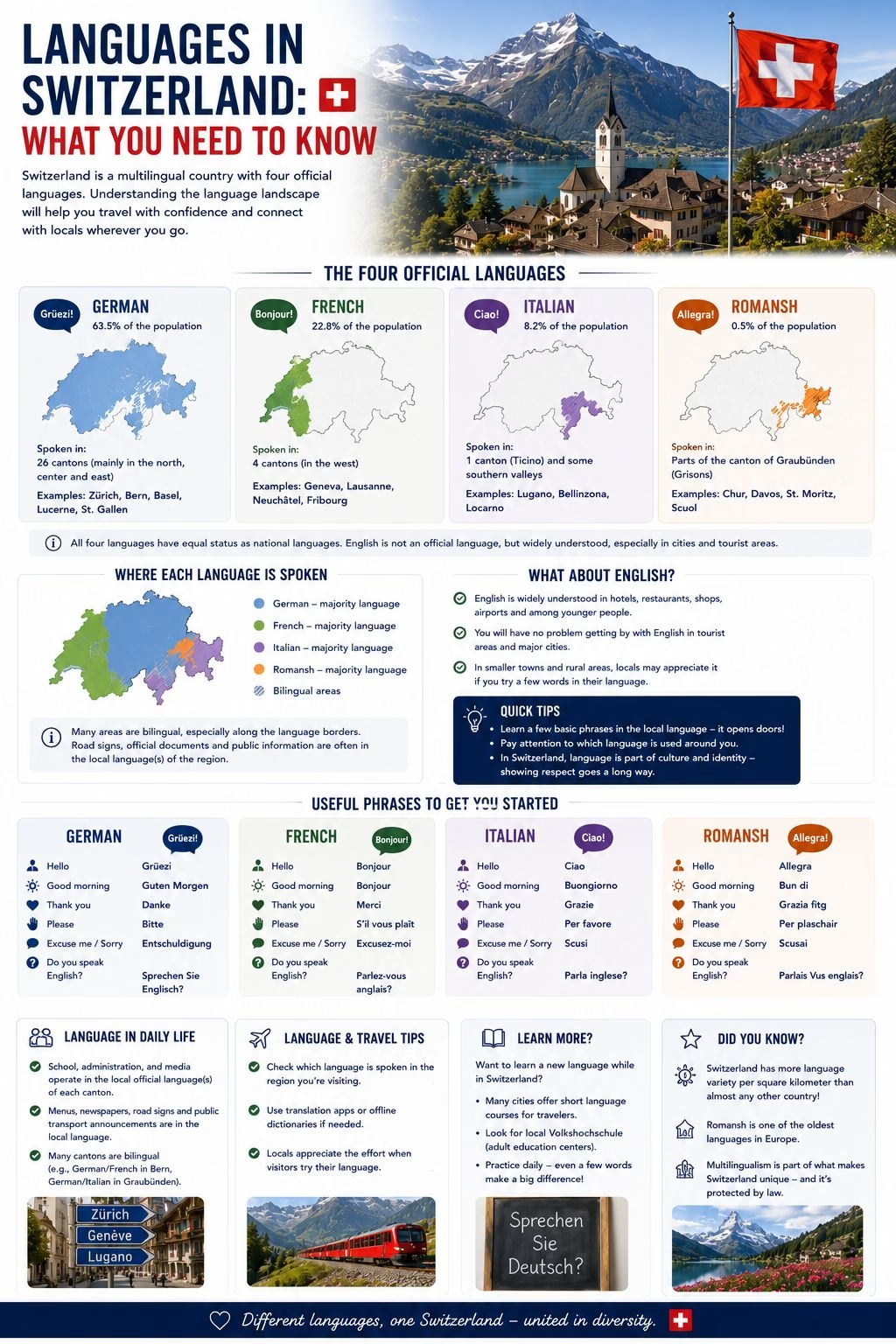
Switzerland has four national languages. Which one you encounter depends entirely on where you are: the country is divided into linguistic regions with clear (though sometimes fuzzy) boundaries, and the cultural character of each region reflects its language as much as its geography. This guide covers the practical language reality for visitors.
The Four Languages and Where They Are Spoken
German (Swiss German and Standard German): The main language of around 62 percent of the population, in the northern, eastern, and central cantons. Cities: Zürich, Bern, Basel, Lucerne, St Gallen, Winterthur, Solothurn, Schaffhausen. The German spoken in everyday life is Swiss German (Schweizerdeutsch), a collection of regional dialects that differ significantly from Standard German (Hochdeutsch). Swiss people use Standard German for writing, news, and formal situations, and switch to it when talking with people who do not understand dialect. Visitors from Germany and Austria often find spoken Swiss German hard to follow at first.
French: The main language of around 23 percent of the population, in the western part of the country known as the Romandie. Cities: Geneva, Lausanne, Fribourg, Neuchâtel, Sion, Montreux. Swiss French is very close to the French of France, with a few differences that visitors notice quickly: numbers such as septante (70) and nonante (90) instead of soixante-dix and quatre-vingt-dix, and in Vaud and Fribourg often huitante (80).
Italian: The main language of around 8 percent of the population, in the canton of Ticino and several southern valleys of Graubünden. City: Lugano, as well as Locarno and Bellinzona. Everyday Italian in Ticino is standard Italian with a local accent and some distinctive vocabulary; the traditional Ticinese dialect, part of the Lombard family, is still heard in informal conversation, especially among older people and in rural areas.
Romansh: Spoken by around half a percent of the population, in parts of the canton of Graubünden. Romansh is a Romance language descended from the Latin spoken in the Alps, distinct from Italian and French, and it exists in several regional varieties. It is a national language and appears on signs and official documents in the areas where it is spoken, but visitors will not need it.
Bilingual Cantons and the Röstigraben
The German-French linguistic boundary is known informally as the Röstigraben (the rösti trench, named after the German-speaking Swiss potato dish). It runs roughly north to south through western Switzerland, and several cantons straddle it: Bern, Fribourg, and Valais are officially bilingual in German and French, and Graubünden is trilingual in German, Romansh, and Italian. The city of Biel/Bienne is the most bilingual town in the country, with street signs in both languages.
The Röstigraben has cultural significance beyond language: voting patterns in national referendums often split along the linguistic border, reflecting genuinely different political and social traditions in the two regions.
English in Switzerland
English is widely understood in Switzerland, particularly in the cities, in the tourism industry, and among younger people. Zürich, Geneva, and Basel have large international communities, and English is common in business and at universities. Many Swiss people also use English as a neutral common language when speaking with someone from another language region.
In tourist areas (hotels, restaurants, mountain railways, museums), English service is standard, and railway announcements on major routes are usually made in English as well as the local language. Outside tourist contexts, particularly in smaller towns and rural mountain areas, English may be more limited, and a few words of the local language are appreciated.
Useful Phrases by Region
Below are the greeting, thanks, and “I don’t speak…” essentials for each language region. In German-speaking Switzerland in particular, greeting people when you enter a shop or small restaurant is expected; see our culture and etiquette guide.
In German-speaking Switzerland
- Grüezi (hello, polite; Grüessech in Bern) / Hoi or Salü (hi, informal)
- Merci vielmal / Danke vielmals (thank you very much)
- Uf Widerluege (goodbye)
- Entschuldigung (excuse me)
- Wo ist…? (where is…?)
- Sprechen Sie Englisch? (do you speak English?)
- Ich spreche kein Deutsch (I don’t speak German)
In French-speaking Switzerland
- Bonjour / Salut (good day / hi)
- Merci beaucoup (thank you very much)
- Au revoir (goodbye)
- Excusez-moi (excuse me)
- Où se trouve…? (where is…?)
- Parlez-vous anglais ? (do you speak English?)
- Je ne parle pas français (I don’t speak French)
In Italian-speaking Switzerland (Ticino)
- Buongiorno / Ciao (good day / hi, bye)
- Grazie mille (thank you very much)
- Arrivederci (goodbye)
- Scusi (excuse me)
- Dov’è…? (where is…?)
- Parla inglese? (do you speak English?)
- Non parlo italiano (I don’t speak Italian)
In Romansh-speaking Graubünden
Everyone who speaks Romansh also speaks German, so you will never need it, but the greeting Allegra (hello) is a friendly touch in the Engadine and other Romansh-speaking valleys, and you will see it on signs and shop doors.
Formal and Informal Address
When speaking to adults you do not know, use the formal form of “you”: Sie in German, vous in French, and Lei in Italian. The Swiss are generally more formal with strangers than people in many other countries, and switching to the informal form (du, tu) is something the other person usually offers first. Starting with a greeting and a polite “Do you speak English?” in the local language, rather than launching straight into English, makes a noticeably better impression.
Related: Culture and Etiquette | Practical Info Hub | Plan Your Trip | Start Here
Written by Laura Meier. Updated regularly as prices and conditions change. Corrections and updates are welcome at contact@allaboutswiss.com.