
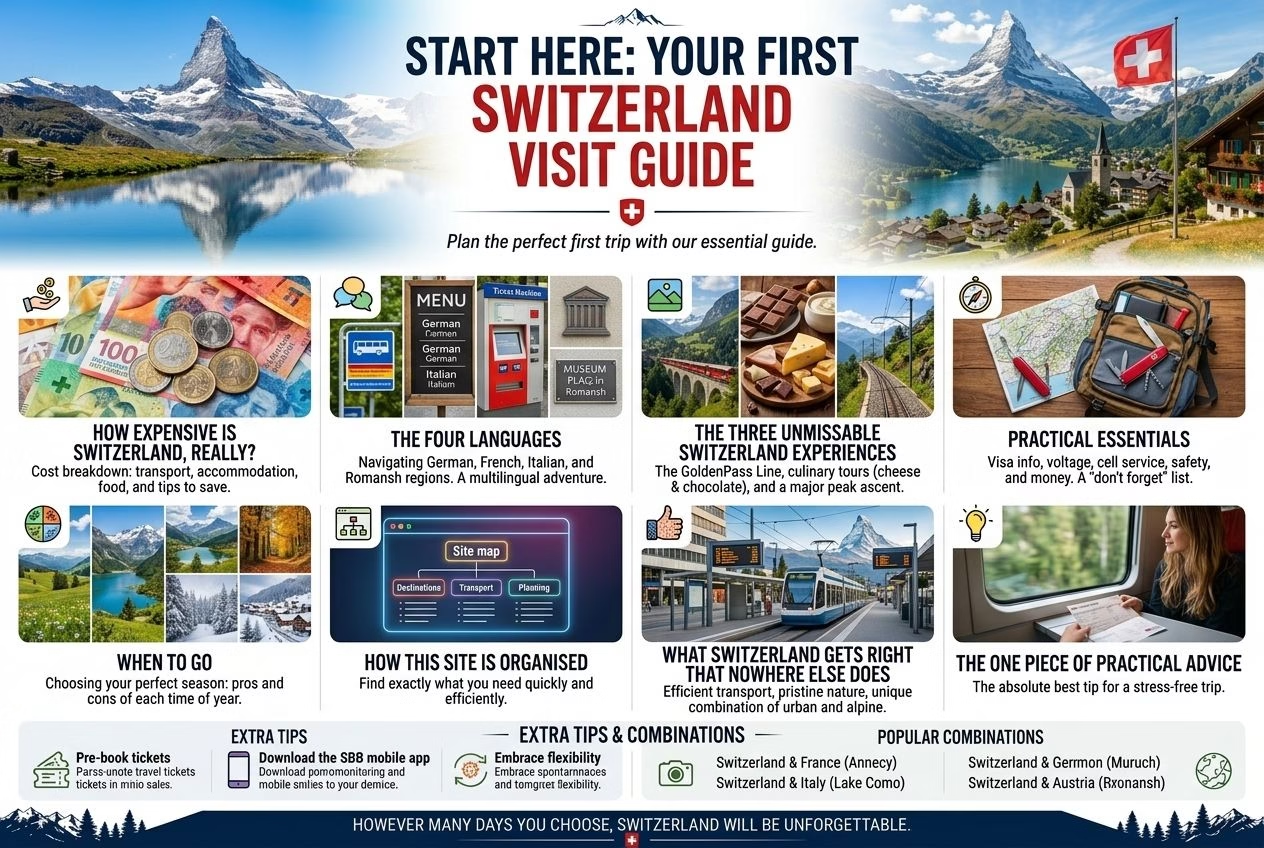
Switzerland is one of the most rewarding and one of the most expensive countries in Europe to visit. Understanding both sides of this equation before you arrive makes the trip significantly better: you arrive prepared for the costs, knowing which transport options represent genuine value, knowing what Switzerland does that nowhere else in the world does, and knowing which of the famous experiences are worth their price and which are mainly famous.
This page is the starting point for a first-time Swiss visit. It covers the questions that need answering before everything else.
How Expensive Is Switzerland, Really?
Switzerland has some of the highest consumer prices in the world: about 71 percent above the EU average in Eurostat’s preliminary 2025 comparison, second only to Iceland in Europe. This is accurate and significant. A coffee costs CHF 4 to 6 (approximately EUR 4 to 6 or GBP 4 to 5); a restaurant lunch for one person, at a typical sit-down restaurant, costs CHF 20 to 35; a night in a mid-range hotel costs CHF 150 to 300 depending on the city and the season. A day lift pass at a major ski resort costs roughly CHF 80 to 115.
These numbers should not deter you: Switzerland delivers value that the price partly justifies, particularly in the transport system, the natural landscape, and the specific quality of the Swiss Alpine experience that is genuinely unavailable anywhere else. But they should inform your planning. The Switzerland travel costs guide covers the current cost landscape with specific benchmarks.
The single most important cost decision for most Switzerland visitors is the transport question. Swiss rail and bus transport is extraordinary in quality and very expensive to use without the right pass. Understanding the Swiss Travel Pass before you arrive, and deciding whether it represents value for your specific itinerary, can save CHF 100 to 300 on a typical visit.
The Four Languages
Switzerland has four official national languages: German (spoken by approximately 63 percent of the population, primarily in the north, east, and centre), French (spoken by approximately 23 percent, primarily in the west, the “Romandie”), Italian (spoken by approximately 8 percent, primarily in the canton of Ticino in the south), and Romansh (spoken by less than 1 percent, in parts of the canton of Graubünden in the east).
This linguistic diversity matters practically. The city you visit determines which language dominates: Zürich, Bern, Basel, and Lucerne are German-speaking; Geneva and Lausanne are French-speaking; Lugano is Italian-speaking. The train announcements, restaurant menus, and signage change as you cross cantonal boundaries.
The practical implication for visitors: English is widely spoken in tourist areas and in the cities, particularly among younger Swiss and in any service role. You do not need to speak German or French to navigate Switzerland as a tourist. Basic German (danke, bitte, Entschuldigung) or French (merci, s’il vous plaît, excusez-moi) is appreciated and serves you well in smaller towns and rural areas.
The Three Unmissable Switzerland Experiences
The train journey through the Alps: Switzerland’s rail network provides access to mountain scenery that would otherwise require weeks of hiking to reach. The Glacier Express between Zermatt and St Moritz, the Bernina Express between Chur and Tirano, and the Jungfraujoch railway are all specific experiences that are genuinely unavailable anywhere else. The Things To Do hub covers the scenic rail options in more detail.
Hiking in the Bernese Oberland or Valais: Switzerland maintains more than 65,000 kilometres of marked hiking trails. The Jungfrau region (accessible from Interlaken and Grindelwald) and the Zermatt area (at the foot of the Matterhorn) have the most spectacular and most accessible Alpine hiking available to visitors without technical mountaineering experience. The hiking hub covers routes for every level.
A lake city in summer: Zürich, Geneva, Lucerne, and Lausanne all have extraordinary lakeside environments that are at their best in summer: swimming in clean Alpine lakes, boat trips to lakeshore villages, the specific quality of light on the water on a clear June morning. This is a Switzerland that photographs do not quite capture and that most visitors discover unexpectedly.
When to Go
Switzerland has four distinct seasons and good reasons to visit in each. The quick guide:
Summer (June to August): Best for hiking, lake swimming, and the full Alpine landscape in green. Crowded and expensive at peak, particularly July and August in the Jungfrau region and Lake Lucerne area.
Autumn (September to October): Arguably the best season for many visitors: the hiking trails are quieter, the light is extraordinary, the Alpine meadows turn golden, and the crowds of high summer have thinned.
Winter (December to March): The skiing season, with the best snow conditions from late December through February. Christmas markets in the cities in December are a specific and genuine experience. Cold in the cities; weather in the mountains is variable.
Spring (April to May): The wildflower season in the lower Alps. Cold and wet at altitude; pleasant in the lake cities. A good time for city visits before the summer crowds.
The best time to visit Switzerland guide covers the seasonal decision in full detail.
Practical Essentials
Visa: Switzerland is in the Schengen Area but is not an EU member. Most Western passport holders do not need a visa for visits up to 90 days. The visa and entry guide covers the requirements for all major nationalities.
Currency: The Swiss Franc (CHF). Euro is accepted at some tourist establishments and at borders but at poor exchange rates; paying in CHF is always better. Credit and debit cards are widely accepted, including contactless. The money guide covers the practical currency situation.
Transport: Switzerland’s public transport system is one of the world’s finest. Understanding it before you arrive, particularly the Swiss Travel Pass question, is the most important practical preparation for a Swiss trip. See the Swiss Travel Pass guide and the getting around guide.
Plugs: Switzerland uses Type J outlets (a three-pin plug specific to Switzerland, different from both the German two-pin Type C and the UK three-pin Type G). Bring a Swiss adapter, not just a general European one.
How This Site Is Organised
Plan Your Trip: Timing, budget, visa, packing, and itinerary frameworks.
Destinations: Full city and regional guides for Zürich, Geneva, Lucerne, Bern, Basel, the Bernese Oberland, and the Alpine towns.
Things To Do: The hiking hub, scenic train guides, lake swimming, food culture, and outdoor activities.
[Winter and Skiing](/winter-skiing/): Resort guides, ski pass costs, Christmas markets, and winter planning.
Practical Info: The Swiss Travel Pass, getting around, money, culture, language, and mountain safety.
[Expat and Nomad](/expat-nomad/): Digital nomad guides, cost of living, residence permits, and long-stay practical information.
Switzerland is complex, expensive, extraordinarily beautiful, and one of the most rewarding destinations in Europe for visitors who come prepared. This site is the preparation.
What Switzerland Gets Right That Nowhere Else Does
The specific things that justify the Swiss price premium are worth naming directly, because they inform every decision about how to use a Switzerland trip well.
The train system is not just good by European standards; it is a fundamentally different quality of experience from train travel in Britain, France, or Italy. The integration of timetables across all operators, the reliability, the scenery of specific routes, and the access to areas that would require a private car in any other country combine to produce a transport experience that is part of the travel destination rather than just a means of getting between points.
The trail network, with 65,000+ kilometres of maintained paths and the specific Swiss tradition of trail marking so precise that following the signs is entirely sufficient without a map, makes the Alpine landscape accessible in a way that equivalent terrain elsewhere in the Alps does not. Grindelwald is connected to the Jungfraujoch by a rack railway that climbs inside the Eiger; from the summit, a maintained path leads to a glacier hut. This level of access to genuinely extreme terrain is uniquely Swiss.
The quality of the water, the cleanliness of the cities, and the reliability of the infrastructure are real and produce a comfort in daily life that is most noticeable when visiting cities where these things are less reliable. The tap water from every public fountain and from the tap is safe to drink; the public toilets are clean; the trains that say they will arrive at a specific time arrive within a minute of that time. These are not small things when they are absent.
The One Piece of Practical Advice
If you are visiting Switzerland for the first time and you have one piece of practical preparation to do before you arrive, it is this: run the Swiss Travel Pass calculation against your specific itinerary before you buy the pass. It takes 15 minutes on the SBB website (sbb.ch), looking up the Supersaver price for each planned journey, and it will either confirm that the pass is good value or save you CHF 100 to 200 in pass costs that would have been wasted.
The Swiss Travel Pass guide provides the full framework for this calculation. It is the single most financially consequential preparation for a Switzerland visit.