
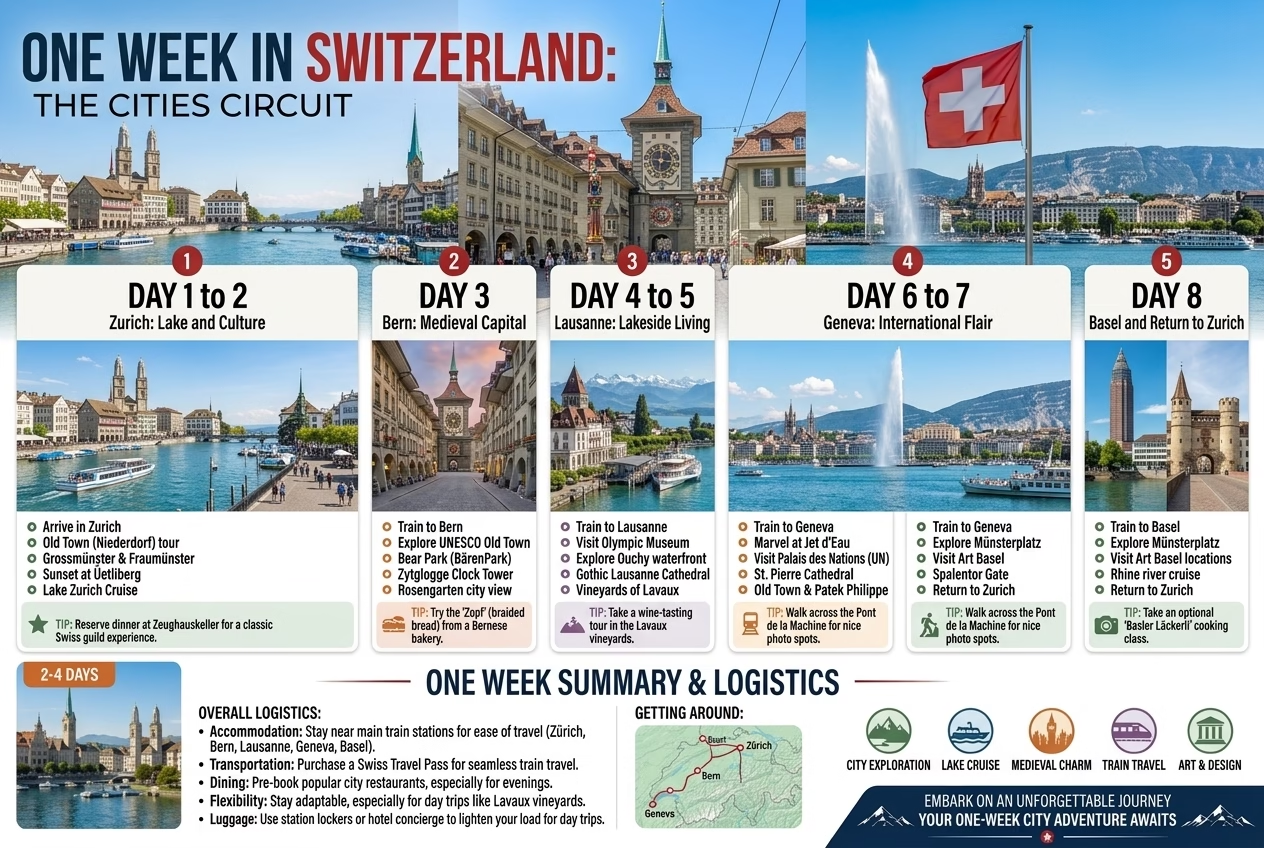
Switzerland’s five major cities (Zürich, Bern, Lausanne, Geneva, and Basel) offer one of Europe’s most concentrated circuits of distinct urban culture within a small geographic area: five cities with genuinely different characters, four different linguistic zones, and connections by direct train that make the logistics entirely straightforward.
Why a Cities-Only Circuit?
The standard Switzerland itinerary advice is to combine cities with Alpine excursions, and this is generally correct. But a visitor with specific urban interests, a trip in winter, a tight schedule that does not allow for the full-day mountain excursions, or a preference for urban culture over hiking can have an extraordinary Switzerland experience focused entirely on the cities.
The cultural diversity between Swiss cities is greater than the geographic distances suggest. Zürich feels German-efficient and commercially sophisticated; Bern feels political and medieval; Lausanne feels young, steep, and intensely francophone; Geneva feels international and expensive; Basel feels artistic, border-aware, and architecturally distinctive. Travelling between them is approximately the same as travelling between London, Manchester, and Edinburgh in terms of time and cost, but the cultural shift between each stop is more dramatic.
The Circuit: Five Cities, Eight Days
Day 1 to 2: Zürich
Start in Zürich as the most internationally connected of the five cities. Two full days covers the Kunsthaus, the Old Town, the Langstrasse neighbourhood, a lake excursion, and a proper evening meal at a traditional Zürich restaurant. Use these two days to orient to Swiss prices, Swiss transport, and Swiss culture.
Day 3: Bern
Direct train from Zürich: 56 minutes. The Bundesstadt (federal capital) has the most architecturally coherent old town in Switzerland; walk the full length of the Lauben arcade, climb the Münster tower for the city panorama, visit the Federal Parliament (free tours on weekdays), and take the Rosengarten view at sunset. The Kunstmuseum Bern, which acquired the disputed Gurlitt collection of war-looted art in 2014, has been one of Switzerland’s most discussed museums since; the collection and the context are both worth engaging with.
Stay overnight in Bern: the city is too often done as a day trip from Zürich, which means missing the specific quality of an evening in the Bern old town when the day-trippers have departed.
Day 4 to 5: Lausanne
Train from Bern to Lausanne: 1 hour 10 minutes. Two nights here, because Lausanne rewards time and is regularly underestimated.
The city is built on three levels: the port district of Ouchy on the lake, the commercial town in the middle, and the old city and cathedral at the top. Navigating between them uses a combination of metro (the M2, one of only two metro lines in Switzerland), funicular, and walking. This topographic drama gives Lausanne an energy quite different from the flat lake cities.
Day 4: The Olympic Museum (Quai d’Ouchy) is a genuine destination rather than a tourist obligation; the permanent collection covers the history of the modern Olympics with strong curation. An afternoon walk along the lakeside promenade to the Lavaux wine village of Lutry (1 hour) provides an introduction to the vineyard landscape before a possible full Lavaux walk the next day.
Day 5: The Lavaux wine route. The pedestrian trail through the UNESCO-listed terraced vineyards between Lutry and Chexbres (approximately 3 to 4 hours one way) is one of the best walks in French-speaking Switzerland: the combination of vineyards, the lake below, and the Alps visible across to the Valais. Return by regional train from Chexbres.
Day 6 to 7: Geneva
Train from Lausanne: 40 minutes. Geneva is the most expensive and the most international of the five cities; it rewards focused exploration rather than general wandering.
Day 6: The old city and the cathedral. The Maison Tavel (oldest house in the city, now a museum) and the Cathedral of St Pierre (the Calvinist reformation centre, now an ecumenical church with an exceptional Gothic interior and a rooftop terrace) are the essential historical stops. The Place du Bourg-de-Four, the oldest square in Geneva, has good cafés and restaurants at prices slightly below the waterfront establishments.
Day 7: CERN or the international quarter. The CERN visitor centre (Microcosm) is free and genuinely informative about the physics. The Red Cross and Red Crescent Museum (Musée International de la Croix-Rouge et du Croissant-Rouge) is the most moving museum in Geneva and one of the best in Switzerland; the permanent exhibition covers the history of humanitarian law and the ICRC with a dignity that matches its subject.
Day 8: Basel and Return to Zürich
Train from Geneva to Basel: 2 hours 45 minutes (direct); or Basel via Bern, 2 hours 20 minutes with change. Basel makes a very good half-day stop on the return journey before the final Zürich connection.
The Basel Kunstmuseum and (if time allows) the Tinguely Museum on the Rhine are both within walking distance of the Basel SBB station. The Mittlere Brücke over the Rhine is one of the most beautiful medieval bridges in Switzerland.
Train from Basel to Zürich: 55 minutes. Basel to Zürich Airport without going through central Zürich takes approximately 60 minutes direct.
Related: One Week in Switzerland | Two Weeks in Switzerland | Zürich Guide | Geneva Guide
Written by Laura Meier. Updated regularly as prices and conditions change. Corrections and updates are welcome at contact@allaboutswiss.com.