
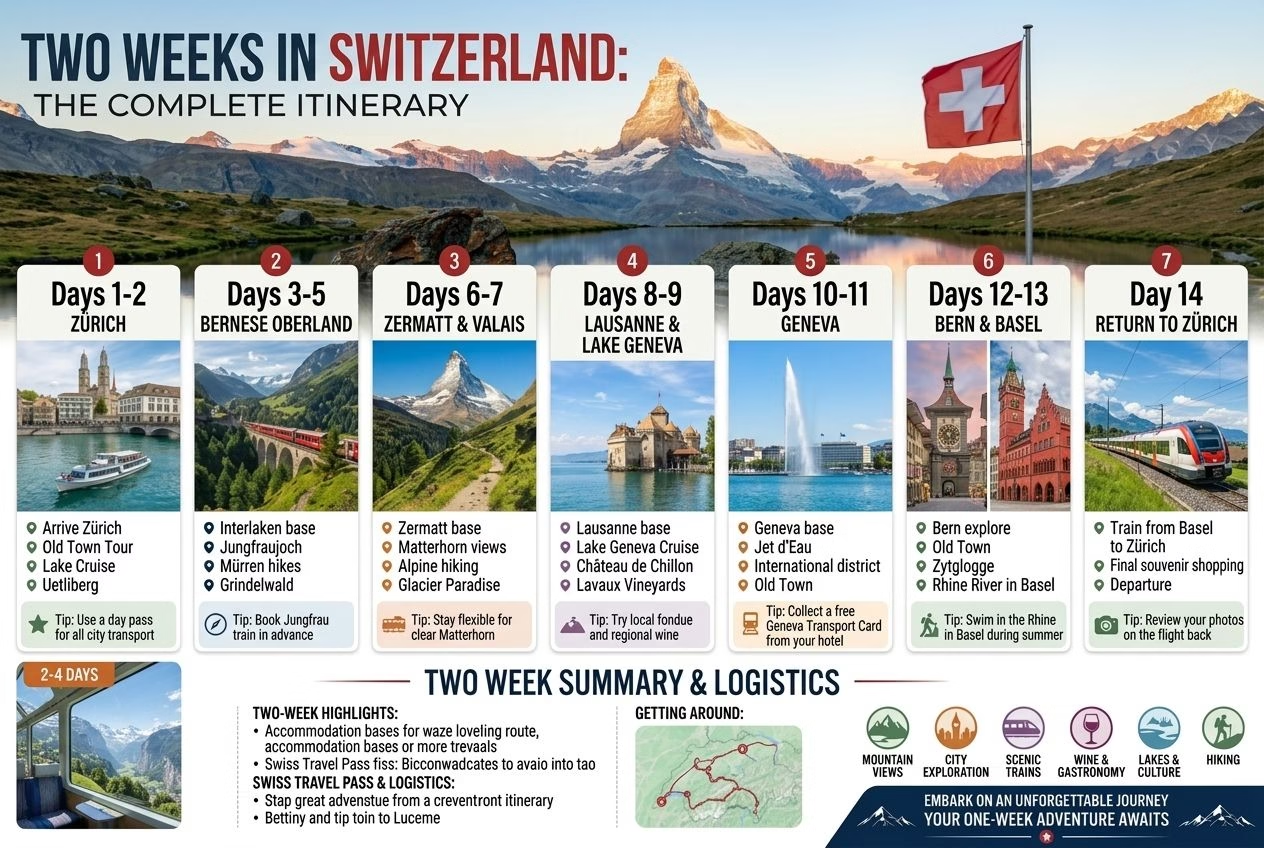
Two weeks in Switzerland allows for the full first-visit experience of the country’s major cities, its most spectacular Alpine regions, and the French-speaking west: the regions and experiences that make Switzerland one of the most diverse small countries in Europe. This itinerary covers the standard two-week circuit with the specific detail needed to actually execute it.
Overview: The Two-Week Circuit
The itinerary follows a geographic logic that minimises backtracking and makes the most of the SBB rail connections. Starting in Zürich (international hub), moving through the Bernese Oberland to the Alpine southwest, then along Lake Geneva to the French-speaking west, and back through Bern and Basel before returning to Zürich.
Days 1 to 2: Zürich
(See the one-week itinerary above for Zürich details; the same day-by-day structure applies.)
Key points: the Kunsthaus, the Old Town, the Lindenhügel quarter, a Lake Zürich excursion, and the Langstrasse evening scene constitute a thorough introduction to Switzerland’s largest city.
Days 3 to 5: The Bernese Oberland
Train from Zürich to Interlaken (2 hours). Base yourself in Grindelwald for these three days; the village is the most centrally located base for the Jungfrau region excursions.
Day 3: Arrival and the Jungfraujoch (full day). Reserve early in the day to maximise the chance of clear weather.
Day 4: Hiking. The First to Bachalpsee loop is the first choice. If weather permits a full ridge walk, the path from First to Grosse Scheidegg (4 hours, challenging) provides views that justify the effort entirely.
Day 5: The Mürren-Schilthorn route. Take the train from Grindelwald to Lauterbrunnen, then the cable car to Mürren (the car-free village on the cliff above the valley). The Panoramaweg from Mürren offers the best Eiger-Mönch-Jungfrau view in the region. Continue to the Schilthorn summit.
Days 6 to 7: Zermatt and the Valais
From Grindelwald or Interlaken, train to Visp (1.5 to 2 hours) and then the Matterhorn Gotthard Bahn to Zermatt (1 hour 20 minutes). Zermatt is car-free: the air is genuinely clean, the horse-drawn carriages are genuine transport rather than tourist theatre, and the Matterhorn is visible from the main street.
Day 6: Arrival and the Matterhorn Glacier Paradise cable car. The Klein Matterhorn station at 3,883 metres is the highest cable car station in Europe. The glacial landscape at the summit, with Italy visible to the south and 14,000-foot peaks in every direction, is one of the most extraordinary viewpoints accessible by cable car anywhere in the world.
Day 7: Hiking around Zermatt. The Schwarzsee lake circuit (3 to 4 hours, accessible by cable car from Zermatt) passes directly beneath the Matterhorn’s north face at approximately 2,500 metres. The Riffelsee lake reflection of the Matterhorn (on clear mornings) is one of the most photographed views in Switzerland.
Days 8 to 9: Lausanne and Lake Geneva
From Visp or Zermatt (return to Visp first), train to Lausanne (2 to 2.5 hours). Lausanne is the French-speaking Swiss city that most surprises first-time visitors: steep, theatrical in topography, with the best restaurant scene in western Switzerland outside Geneva, and one of the most remarkable Gothic cathedrals in Europe.
The Olympic Museum on the lakeside in Ouchy is world-class by the standards of any specialist museum. The Fondation de l’Hermitage above the city has rotating exhibitions of major French and Swiss 19th and 20th-century art.
Day 9: The Lavaux vineyards by boat or on foot. The terraced vineyards between Lausanne and Montreux are a UNESCO World Heritage Site; the wine trail through them (the Lavaux pedestrian route, approximately 3 hours) provides a combination of extraordinary scenery and wine tasting at the village cooperative cellars.
Days 10 to 11: Geneva
Geneva is 40 minutes from Lausanne by direct train. The city divides into the international district (UN, WHO, Red Cross, CERN) and the old city: the combination makes Geneva unlike any other Swiss city. It is more cosmopolitan and more expensive than the rest of Switzerland.
The Jet d’Eau, the 140-metre water jet on the lake, has become Geneva’s defining image. The Old Town (Vieille-Ville) on the hill above the south shore of the lake has the Cathedral of St Pierre (with its roof terrace, free, for views), the Maison Tavel (the oldest house in Geneva, now a history museum), and the exceptional Musée d’Art et d’Histoire.
CERN, the European Organization for Nuclear Research, offers guided tours and a visitor centre (Microcosm) explaining particle physics; advance booking required. The Globe of Science and Innovation on the CERN campus is architecturally extraordinary and free to visit without a tour.
Days 12 to 13: Bern and Basel
From Geneva, direct fast trains reach Bern in 1 hour 40 minutes. The federal capital’s Altstadt, on the peninsula formed by the Aare river’s crook, is the most intact medieval city centre in Switzerland: the 6-kilometre arcade system, the Bear Park, the Rosengarten view, and the Federal Parliament buildings are all within walking distance.
From Bern, Basel is 1 hour by direct train. Basel has a specific cultural identity distinct from any other Swiss city: it is the art capital of Switzerland (Art Basel, the world’s most important contemporary art fair, is held here in June), the pharmaceutical industry capital (Roche and Novartis are headquartered here), and a three-country city at the point where Switzerland, Germany, and France meet.
The Kunstmuseum Basel is one of the oldest and most comprehensive public art collections in the world; the Foundation Beyeler (20 minutes from the city in Riehen) holds one of Europe’s finest collections of 20th-century art in a beautiful Renzo Piano building.
Day 14: Return to Zürich
Basel to Zürich is 55 minutes by direct InterCity train. A final morning in Zürich before departure, or direct to the airport (Zürich HB to Zürich Airport is 10 minutes by direct S-Bahn).
Related: One Week in Switzerland | Switzerland Cities Circuit | Plan Your Trip | Destinations
Written by Laura Meier. Updated regularly as prices and conditions change. Corrections and updates are welcome at contact@allaboutswiss.com.