
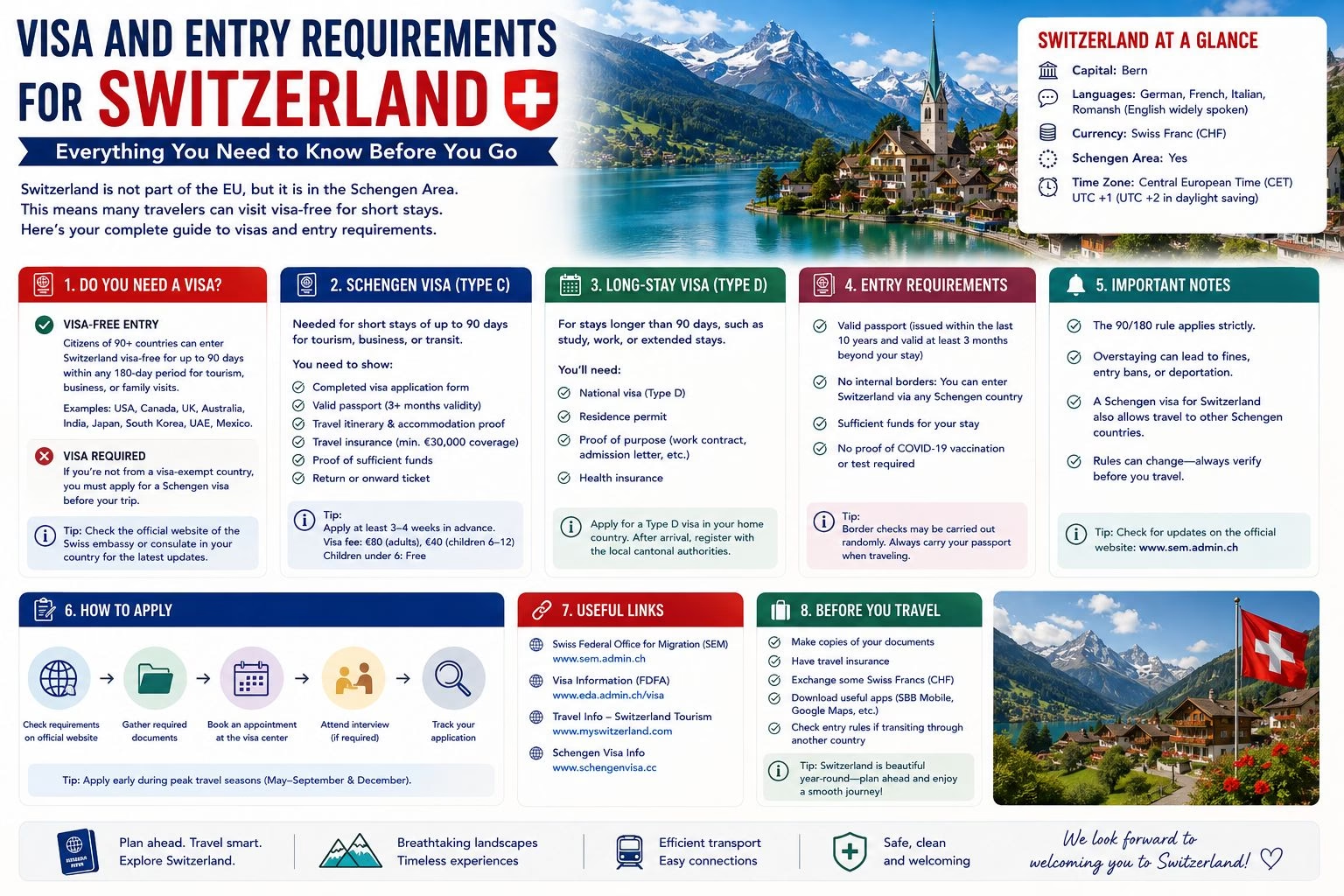
Switzerland is not a member of the European Union but is fully integrated into the Schengen Area, the zone of 27 European countries that operate shared external borders and free internal movement. This has significant practical implications for visitors: Switzerland uses the Schengen visa system, which means that a Schengen visa issued for another country is valid for Switzerland, and that Switzerland’s external entry requirements align with those of the broader Schengen zone.
Visa-Free Entry: Who Qualifies
The following nationalities can enter Switzerland without a visa for tourism purposes, for stays of up to 90 days in any 180-day period:
All EU and EEA member state citizens (this is a longer-term right of free movement, not merely visa-free tourism).
UK nationals: despite Brexit, UK citizens retain visa-free access to the Schengen Area including Switzerland for up to 90 days in any 180-day period for tourism. This is subject to the ongoing evolution of UK-EU relations; verify the current position before travel.
US, Canadian, Australian, New Zealand, Japanese, South Korean, and many other nationalities have visa-free 90-day Schengen access.
Switzerland’s federal immigration authority (SEM: Staatssekretariat für Migration) maintains the authoritative and current list of visa-exempt nationalities. Check sem.admin.ch before travel; the list is updated periodically.
The 90-Day Schengen Rule: How It Works
The 90-day limit is calculated as 90 days within any rolling 180-day period, not 90 days per calendar year. This distinction matters for frequent visitors and for visitors who plan to combine a Switzerland stay with other Schengen countries.
An example: if you spent 60 days in Germany in January and February, then wish to visit Switzerland in March, you have used 60 of your 90 Schengen days and may only stay in Switzerland (or any other Schengen country) for a further 30 days before the 180-day window resets. The calculation rolls forward continuously rather than resetting on a fixed date.
This rule applies to the entire Schengen Area, not to Switzerland specifically. Time spent in Germany, France, Italy, Austria, the Netherlands, or any other Schengen member state counts toward the 90-day limit equally with time spent in Switzerland.
What You Need at Entry
For visa-free travellers entering Switzerland:
A valid passport with at least three months of remaining validity beyond your intended departure date from the Schengen Area. Some nationalities may use national identity cards instead of passports; check your specific situation.
Proof of sufficient funds: Swiss border officials can (and occasionally do) ask for evidence that you can support yourself during your stay. A credit card and some cash, or a bank statement, is usually sufficient to demonstrate this.
A return or onward ticket: demonstrating that you have a plan to leave Switzerland before your permitted stay expires.
Travel insurance: the Schengen Area technically requires visitors to have travel insurance with minimum medical coverage of EUR 30,000. This requirement is not always enforced at border crossings but is a genuine legal requirement and should be met regardless.
Visa Categories for Nationalities That Require a Visa
Nationals of countries not on the Schengen visa-exempt list must apply for a Schengen visa before travel. For visits to Switzerland specifically, the application is made at the Swiss embassy or consulate in your country of residence.
The standard tourist visa (Schengen Type C) is valid for stays of up to 90 days within 180 days and can be single entry or multiple entry. A long-stay Swiss national visa (Type D) is required for stays longer than 90 days, such as those covered by a work permit or residency application.
Visa applications require: a completed application form; passport-sized photographs; proof of accommodation bookings; proof of onward travel; travel insurance; proof of financial means; and the visa fee.
Processing times vary significantly by consulate; applying at least 4 to 6 weeks before planned travel is advisable, and longer during busy periods.
ETIAS: The European Travel Information and Authorisation System
The EU is implementing ETIAS, an electronic travel authorisation system for visa-exempt non-EU nationals entering the Schengen Area, including Switzerland. The system, modelled on the US ESTA, requires pre-travel registration and payment of a small fee. Implementation has been delayed repeatedly; check the current status before travel, as ETIAS may be in operation by the time you read this.
EU and EEA Citizens: The Specific Situation
EU and EEA citizens have the right to live, work, and remain in Switzerland under a series of bilateral agreements between Switzerland and the EU (the Bilateral Agreements, particularly Agreement on the Free Movement of Persons). This is a stronger right than visa-free tourism access. EU and EEA citizens can enter Switzerland with a valid national identity card (passport not required in many cases) and can register as residents if staying for more than 90 days.
Entering Switzerland from a Schengen Country
Switzerland has land borders with Germany, France, Italy, Austria, and Liechtenstein. All of these except Liechtenstein are Schengen members. Crossing from a Schengen country into Switzerland is technically a Schengen internal border crossing: there are no systematic passport controls, though spot checks occur and Swiss customs officers can request identification at any time.
Customs controls do apply at Switzerland’s borders even within the Schengen Area: Switzerland is in the Schengen zone for people but maintains its own customs territory (not in the EU customs union). Duty-free allowances for goods brought into Switzerland from EU countries apply, and goods above the value limit (CHF 300) are subject to customs duty and Swiss VAT.
Long-Stay Visas and Residence Permits
For stays longer than 90 days, Switzerland offers a range of residence permit categories. These are covered in detail in the expat and nomad section; the relevant categories for most digital nomads and longer-term visitors include the short-stay visa (Type C, up to 90 days, tourism or work visiting purposes), the long-stay visa (Type D, for initial entry to establish residence under a permit), and the various Swiss residence permit categories (L, B, C, G) that apply once residing in Switzerland.
Related: Plan Your Trip | Switzerland Travel Costs | Expat and Nomad Hub | Start Here
Written by Laura Meier. Updated regularly as prices and conditions change. Corrections and updates are welcome at contact@allaboutswiss.com.