
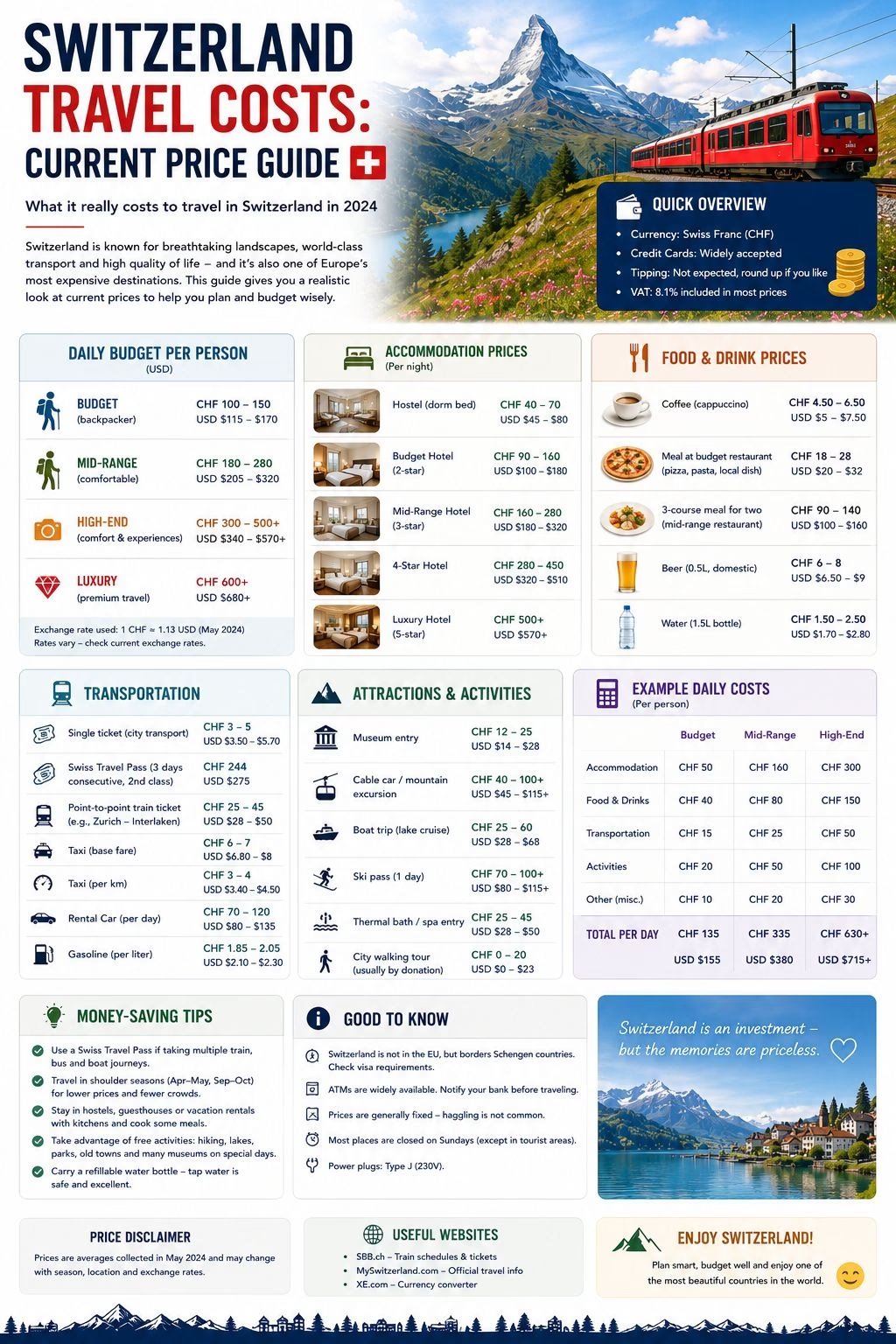
Switzerland is expensive. The question is not whether it is expensive but how expensive, for what, and where the value lies. This guide provides current price benchmarks across all major spending categories, explains where the Swiss price premium is unavoidable and where it can be mitigated, and gives realistic daily budget estimates for different travel styles.
The Currency: Swiss Franc (CHF)
Switzerland uses the Swiss Franc (CHF, or colloquially written as Fr. or SFr.). The exchange rate against major currencies fluctuates; as a rough working guide, CHF 1 is approximately EUR 1.02 to 1.05, GBP 0.88 to 0.92, and USD 1.08 to 1.12. The Swiss Franc is one of the world’s strongest currencies, and the exchange rates mean that Switzerland’s prices, which are high in CHF, are even higher when converted from most visitor currencies.
All prices in this guide are in CHF. Verify current exchange rates before travel.
Accommodation Costs
Switzerland has accommodation at every price point, but the floor is higher than in most European countries:
Hostel dormitory: CHF 35 to 75 per person per night in cities; CHF 45 to 90 in Alpine resort areas.
Budget double room (guesthouse or lower-tier hotel): CHF 100 to 180 in cities; CHF 120 to 220 in resort areas.
Mid-range hotel double: CHF 180 to 300 in Zürich, Geneva, Bern; CHF 200 to 350 in Lucerne and the tourist towns; CHF 250 to 450 in ski resorts during peak season.
Boutique and quality hotels: CHF 300 to 600+ depending on location and season.
The ski resort premium is significant. Zermatt and St Moritz hotel prices during peak winter weeks can exceed CHF 600 to 800 per night for mid-range rooms. Grindelwald and Wengen are cheaper than Zermatt. Staying in a base town (Visp for Zermatt, Interlaken for the Jungfrau region) and taking the train or gondola up reduces accommodation costs substantially.
Food and Drink Costs
Grocery shopping at Migros or Coop (the two main supermarket chains) costs approximately 20 to 40 percent more than equivalent shopping in Germany. A simple self-catering day (breakfast and lunch from the supermarket) costs CHF 20 to 35 per person.
Bakery and café breakfast: CHF 8 to 16 for a coffee and croissant or pastry. Swiss bakeries (Bäckerei, boulangerie) are excellent and breakfast from a bakery is one of the more affordable eating options.
Tagesmenu / menu du jour: The fixed-price weekday lunch menu at most Swiss restaurants. Typically CHF 18 to 28 for two or three courses. This is the best value eating option in Switzerland and how many Swiss workers eat lunch during the week.
Restaurant lunch, à la carte: CHF 22 to 40 for a main course.
Restaurant dinner, good independent restaurant: CHF 30 to 65 for a main course; CHF 60 to 120+ per person for a full meal with wine at a quality establishment.
Beer at a bar: CHF 6 to 9 for a 33cl glass.
Coffee (espresso): CHF 3.50 to 5.50 at a café; CHF 2.50 to 4 from a bakery.
Fondue at a traditional restaurant: CHF 28 to 45 per person; this is one of the Swiss restaurant experiences worth paying for at least once.
Transport Costs
Transport is where the Swiss price premium is most concentrated and most susceptible to mitigation with the right planning.
Without a pass, individual SBB train tickets:
Zürich to Geneva: CHF 85 to 95 one way (full fare); CHF 50 to 60 with 30-day advance Sparticket.
Interlaken to the Jungfraujoch summit railway: CHF 100 to 145 return depending on departure point.
Zermatt Matterhorn Gotthard cable car to Klein Matterhorn: CHF 95 to 100 return.
Swiss Travel Pass:
3 days: CHF 244 (2nd class); CHF 409 (1st class).
The pass provides unlimited travel on SBB trains, PostBus, and lake steamers; free or discounted access to mountain railways; and free entry to many museums. Whether it provides value over individual tickets depends entirely on your specific itinerary. The Swiss Travel Pass guide contains the calculation framework.
Activity Costs
Mountain railways and gondolas are among Switzerland’s most significant specific costs:
Jungfraujoch (Top of Europe): CHF 100 to 145 return from Grindelwald or Kleine Scheidegg.
Klein Matterhorn (Zermatt): CHF 95 to 100 return.
Pilatus (from Lucerne, combined boat/cable car/rack railway): CHF 90 to 112 for the classic round trip.
Rigi (from Lucerne or Vitznau): CHF 55 to 72 return.
Schilthorn/Piz Gloria (from Lauterbrunnen/Grindelwald area): CHF 90 to 105 return.
Hiking itself is free on public trails; the cost is in the mountain railways needed for access. Many excellent hikes are accessible without paying for a mountain railway: the trails around Grindelwald at lower altitudes, the Jura ridge walks, and valley-level routes throughout Switzerland require no lift access.
Museum entry: CHF 12 to 25 for most Swiss museums; free with Swiss Travel Pass for many.
Swimming in a public Freibad (outdoor pool) or at a lake lido: CHF 6 to 12 for adults.
Daily Budget Estimates
Budget traveller (hostel, self-catering lunches, occasional restaurant dinner):
CHF 120 to 170 per day excluding transport.
Mid-range traveller (mid-range hotel, Tagesmenu lunches, one good restaurant per day):
Comfortable traveller (quality hotel, good restaurants):
Adding transport (Swiss Travel Pass or individual tickets) typically adds CHF 40 to 80 per day for a visitor making regular journeys.
Where to Find Value
Switzerland is expensive but not uniformly expensive. Some specific value observations:
Supermarket chains Migros and Coop have good-quality prepared food counters and hot food sections at lunch; eating from these is significantly cheaper than any sit-down restaurant and the quality is reliably good.
The Helvetic Kitchen has elevated Swiss food beyond the fondue-and-rösti stereotype; good modern Swiss cooking at reasonable prices exists particularly in Zürich’s residential neighbourhoods away from the tourist centre.
City day passes on public transport (Zürich, Geneva) provide unlimited local transport at CHF 8 to 12 per day; the 24-hour pass on the Zürich public transport network is CHF 8.80 and covers trams, buses, and the lake boats within the zone.
Related: Plan Your Trip | Swiss Travel Pass Guide | Best Time to Visit | Itineraries
Written by Laura Meier. Updated regularly as prices and conditions change. Corrections and updates are welcome at contact@allaboutswiss.com.