
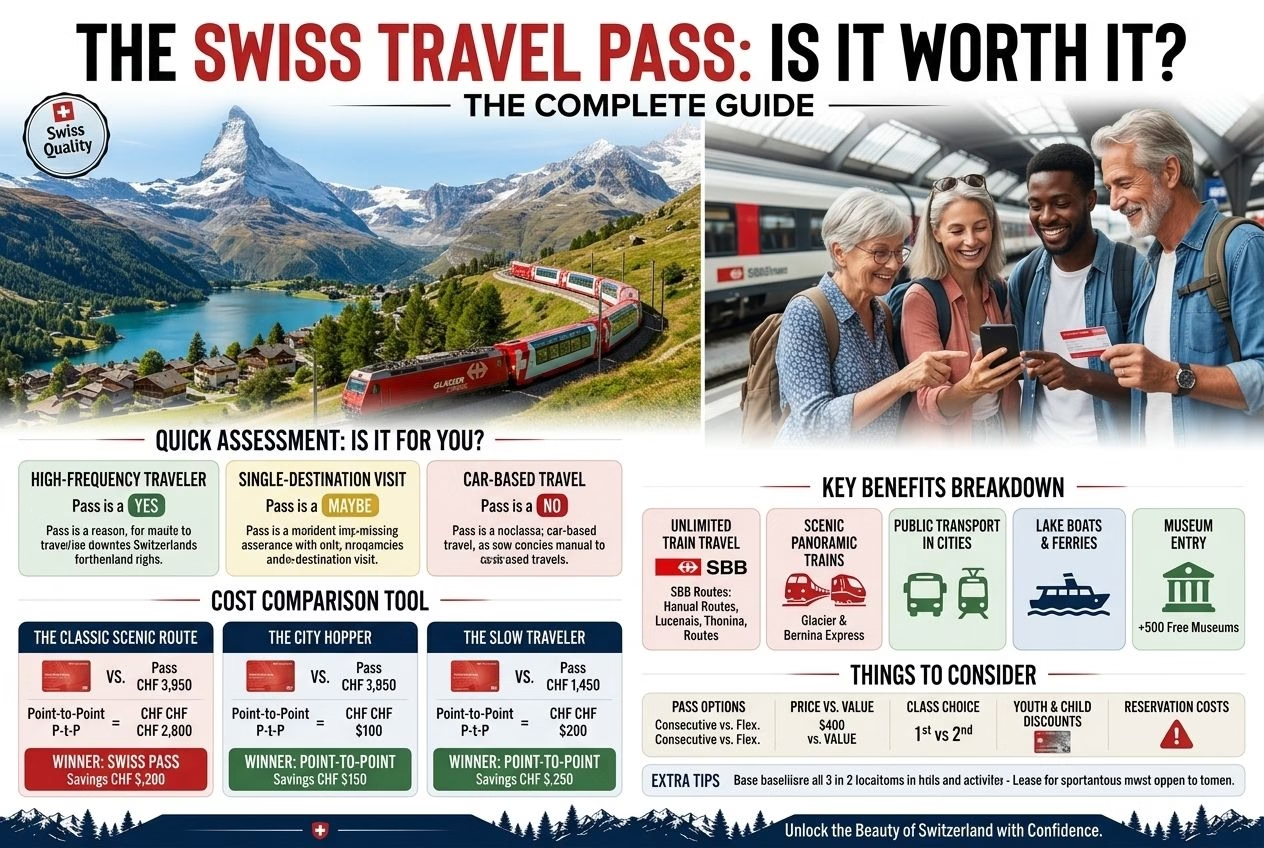
The Swiss Travel Pass is the most commonly purchased and most commonly miscalculated transport product in Switzerland. Every year, visitors who would have been better served by point-to-point tickets buy the pass because “Switzerland has amazing trains and we want to take them all”; and every year, visitors who would have saved money with the pass spend more on individual tickets because they did not work through the calculation. This guide provides the framework to make the right decision for your specific trip.
What the Swiss Travel Pass Includes
Unlimited travel on SBB (Swiss Federal Railways) trains: All InterCity, InterRegio, and regional trains on the entire SBB network, available in 2nd class (the base price) or 1st class (roughly 55 to 60 percent more expensive).
All PostBus services: The PostBus (yellow buses) network covering more than 850 routes through valleys, villages, and mountain areas not served by rail. This is one of the most underappreciated aspects of the Swiss Travel Pass; PostBus access enables travel to areas that are otherwise only accessible by private car.
Lake steamers: All SBB-operated and affiliated lake steamer services on the major Swiss lakes (Lake Lucerne, Lake Zürich, Lake Thun/Brienz, Lake Geneva, Lake Constance, Rhine cruise). The lake steamer network, which provides scenic transport between lakeside towns and boat access to mountain railway connections, is a specific Swiss experience that the pass makes economical.
City public transport in 75 towns and cities: The pass includes public transport in the cities of Zürich, Geneva, Bern, Basel, Lucerne, and most other major Swiss towns. In Zürich specifically, this covers unlimited use of trams, buses, S-Bahn trains, and lake boats within the city zone; this alone saves CHF 8.80 per day (the daily Zürich public transport ticket price).
Mountain railway discounts: Most Swiss mountain railways (cableways, gondolas, and rack railways) give Swiss Travel Pass holders a 25 to 50 percent discount, and a few are fully covered. The specific discount varies by operator; check the Swiss Travel Pass website for the current list.
Free museum entry: More than 500 Swiss museums offer free admission with the Swiss Travel Pass.
What the Pass Does Not Fully Cover
Ski resort lift passes: These are commercial leisure services, not public transport; no discount is offered (some resorts offer a small separate discount but it is not part of the pass).
Glacier Express seat reservation: The Glacier Express route is covered by the pass, but the mandatory seat reservation is a separate cost that no pass covers: CHF 54 per person per journey in 2026, the same in 1st and 2nd class, and unchanged for 2027 (only the Excellence Class reservation rises, from CHF 540 to CHF 590 from December 2026).
The Jungfraujoch: Travel from Interlaken to Grindelwald or Wengen is free with the pass; the section from Grindelwald or Wengen up to the Jungfraujoch is discounted by 25 percent, not free. In 2026, that brings the peak-season (May to October) return trip from Interlaken to about CHF 179.60 with the pass, compared with CHF 261.20 at full fare. From May to October a seat reservation for the final section is also mandatory, at around CHF 10 extra.
Other mountain excursions: The Schilthorn cable car and the Pilatus cable car are discounted by 50 percent rather than included.
Private railway operators with separate pass structures: Some operators (notably the MOB for the GoldenPass route and several narrow-gauge lines in Graubünden) require a separate supplement or are only partially covered.
The Swiss Travel Pass Types and Prices (2026 and 2027)
Consecutive days (standard): Unlimited travel for a set number of consecutive days.
3 consecutive days: CHF 254 (2nd class); CHF 405 (1st class). Prices rise for longer durations: 4 days CHF 309, 6 days CHF 399, 8 days CHF 439, 15 days CHF 499 (all 2nd class; 1st class runs roughly 55 to 60 percent more). Swiss Travel System has confirmed that the pass prices stay the same in 2027, while regular point-to-point fares rise by an average of 3.6 percent from December 2026, which slightly improves the pass against full-fare tickets.
Flex Pass: A flex pass allows use on any 3, 4, 6, or 8 days within a 1-month period; travel days do not need to be consecutive. The flex pass costs roughly 4 to 14 percent more than the consecutive equivalent, with the premium shrinking as the number of days grows.
Youth prices (ages 16 to 24, up to the day before the 25th birthday): roughly 30 percent below the adult price.
Children under 16: free with accompanying adult holding a Swiss Travel Pass and the Family Card (Familienkarte).
The Calculation: Is It Worth It for Your Trip?
The Swiss Travel Pass is worth buying if the total cost of your journeys without it exceeds the pass price. The key is to compare like with like: the discounts on mountain railways, the Jungfraujoch, and museums only exist if you hold the pass, so they belong in the pass column, not the point-to-point column. Here is the calculation framework:
Step 1: List every train, PostBus, and lake steamer journey you plan to make.
Step 2: Look up each journey on sbb.ch or the SBB Mobile app. Check for Supersaver tickets (Sparbillette / billets dégriffés): these offer discounts of up to 50 percent, and up to 70 percent on selected trains, with the best availability off-peak and when booked early. They are tied to a specific train and are non-refundable, so they suit fixed plans. Use the Supersaver price where you would realistically book one, and the full fare where you want flexibility.
Step 3: Add city public transport you would otherwise pay for (CHF 8.80/day in Zürich; CHF 3 to 10/day in other cities, depending on how much local transport you use).
Step 4: Add your mountain excursions at their full, no-pass price.
Step 5: For the pass side, take the pass price and add what you would still pay with it: the discounted excursion fares (for example, 75 percent of the Jungfraujoch fare from Grindelwald or Wengen) and any reservation fees.
Step 6: Compare the two totals. If the no-pass total is higher, the pass is worth buying.
Specific Itinerary Examples: Pass vs No Pass
One-week Zürich/Lucerne/Interlaken circuit, moderate train use (6 to 8 rail journeys) including the Jungfraujoch:
The Jungfraujoch alone shapes this calculation. Without a pass, the peak-season return trip from Interlaken costs CHF 261.20; with the pass it costs about CHF 179.60, a saving of roughly CHF 80 on one excursion. Add city transport in Zürich and Lucerne, a boat trip on Lake Lucerne, and the intercity legs (Zürich to Lucerne, Lucerne to Interlaken, Interlaken back to Zürich), and the no-pass total depends heavily on how many of those legs you can get as Supersavers. Lucerne to Interlaken, for example, is CHF 34 one-way at full fare but can drop to around CHF 10 on a Supersaver train.
Result: at full fares, a 6-day pass (CHF 399) is close to break-even or better for this trip. If you book the intercity legs early as Supersavers and skip the boat and city transport, point-to-point tickets usually come out cheaper. Run both totals before deciding.
Two-week circuit including Geneva, Bern, Zermatt, St Moritz, and Zürich (12 to 15 rail journeys):
With this many long journeys, the individual fares add up well beyond the 15-day pass at CHF 499, even with some Supersaver bookings. The pass is clearly the better value, and it removes the need to commit to specific trains.
Three days in Zürich only (2 to 3 journeys):
Individual tickets for 2 to 3 city-to-city journeys plus city transport: CHF 80 to 120. The 3-day pass at CHF 254 is not worth it.
Consider the Half Fare Card too: For trips built around expensive mountain excursions rather than lots of train travel, the Swiss Half Fare Card is worth pricing as a third option. It halves most fares, including the whole Jungfraujoch route (about CHF 130.60 return from Interlaken in peak season 2026), and can be combined with Supersaver tickets.
The pass is available at Swiss airport and station ticket offices on arrival (but at the listed price, not discounted). The best prices are through the official Swiss Travel System website (swisstravelsystem.com) or through authorised agents before departure. Pre-departure purchases sometimes come with promotional discounts not available at the station window.
Related: Getting Around Switzerland | SBB Trains | Plan Your Trip | Is Switzerland Worth It?
Written by Laura Meier. Updated regularly as prices and conditions change. Corrections and updates are welcome at contact@allaboutswiss.com.