
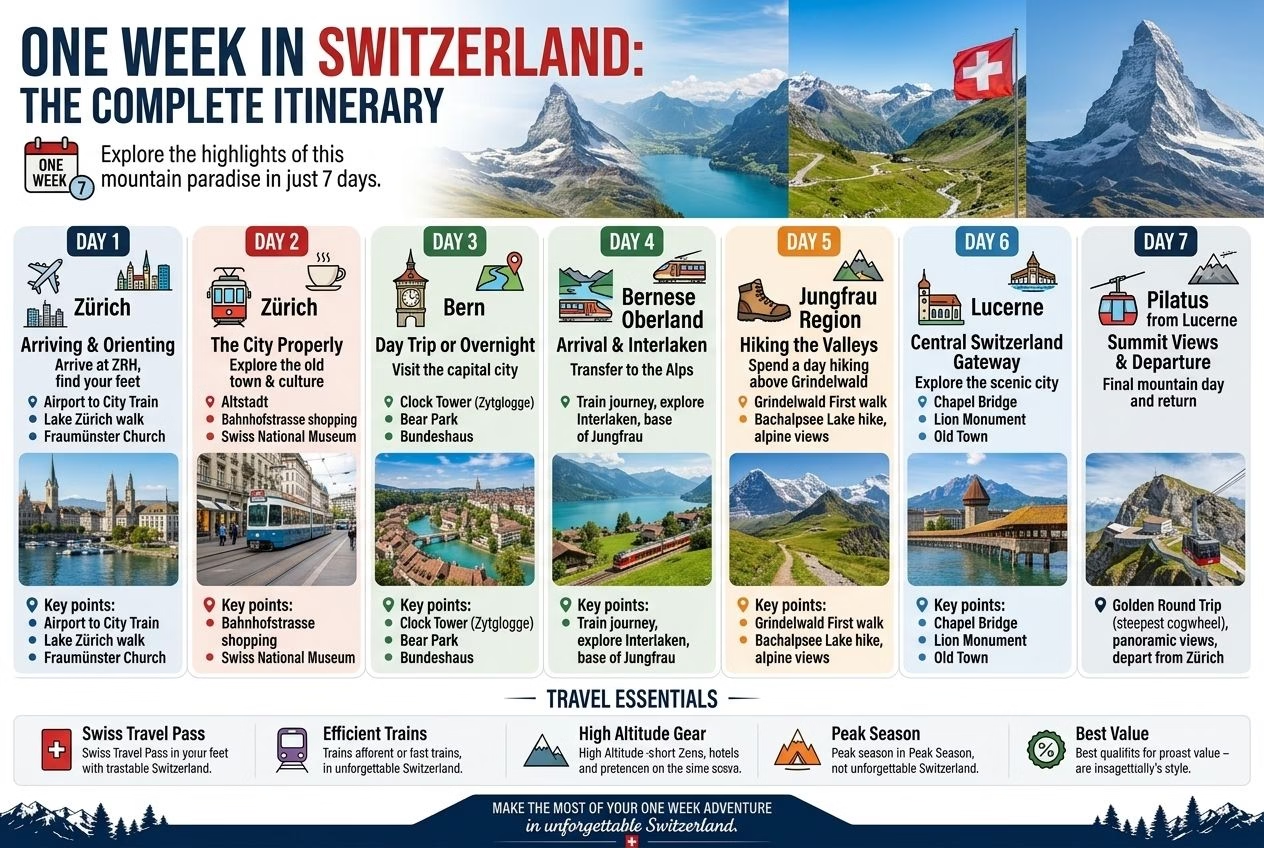
One week in Switzerland allows for a genuine experience of two or three distinct regions without rushing. The itinerary below covers Switzerland’s most rewarding first-visit combination: Zürich as the entry city, the Bernese Oberland for the Alpine experience, and Lucerne for the lake-and-mountain setting that has made it Switzerland’s most photographed city. All connections are by direct train; no car is needed.
Day 1: Zürich, Arriving and Orienting
Arrive at Zürich Airport and take the direct S-Bahn train to Zürich Hauptbahnhof (10 minutes, trains every 6 to 10 minutes). The Hauptbahnhof itself is worth a moment: it is the largest rail station in Switzerland and one of the most architecturally impressive in Europe, with an Art Nouveau hall flanked by more recent additions.
Check into accommodation. For a first Zürich visit, staying in the Old Town (Altstadt) or in the Langstrasse neighbourhood (more interesting and cheaper than the Old Town) puts you within walking distance of the main sights.
Afternoon: Walk through the Niederdorf quarter, the medieval heart of the city on the eastern bank of the Limmat river. The streets of Niederdorf, particularly the Niederdorfstrasse and the alleys branching from it, contain small cafés, independent shops, and the concentrated architecture of 700 years of Swiss urban history.
Evening: The Lindenhügel (Lindenhügelplatz) area of the Old Town has good restaurants without the Bahnhofstrasse tourist pricing. Try a Zürich-specific dish: Zürcher Geschnetzeltes (veal in cream sauce with rösti) is the city’s signature dish and available at most traditional restaurants.
Day 2: Zürich, The City Properly
Morning: The Kunsthaus Zürich, one of Europe’s finest art museums, holds one of the most important collections of modern art in the world. The Chagall stained glass windows in the Fraumünster church (a short walk from the Kunsthaus) are a specific Zürich experience worth the modest entry fee.
Take the Polybahn funicular from Central square up to the ETH (Swiss Federal Institute of Technology) terrace for the view over the city and the lake.
Afternoon: Lake Zürich itself. The Zürichsee-Fähre boat service from the Bürkliplatz runs along the lake to several swimming spots and villages; in summer, the Strandbad Mythenquai public lido provides lake swimming with a view of the Alps at the southern end. The boat to Rapperswil (1 hour each way) is one of the best introductions to the specific quality of Swiss lake scenery.
Evening: The Langstrasse district, Zürich’s most diverse and most alive neighbourhood for evening eating and drinking: cheaper than the tourist centre, genuinely local, with a concentration of good restaurants from Swiss-Italian to Turkish to modern European.
Day 3: Bern, Day Trip or Overnight
Bern is 56 minutes from Zürich by direct InterCity train (CHF 50 to 52 full fare; discounted advance tickets available). The federal capital has a quality of preserved medieval architecture that justifies at least a day trip, and ideally an overnight.
The Rosengarten (Rose Garden) above the city gives the famous view over the old town and the Aare river bend that defines Bern’s topography. Walk down into the Altstadt through the Bundesgasse to the Federal Parliament (Bundeshaus), where free tours run on weekdays.
The covered arcades (Lauben) that line the main streets of Bern are one of Europe’s great urban infrastructure achievements: 6 kilometres of covered walking in the city centre, protecting pedestrians from rain and sun since the 12th century. The Zytglogge (Clock Tower) at the western end of the main arcade has an astronomical clock from 1530 that performs on the hour.
The Einstein Museum and the Museum of Fine Arts (Kunstmuseum Bern, including the Paul Klee Centre nearby) represent the depth of Bern’s cultural institutions.
Day 4 to 5: The Bernese Oberland (Interlaken and Grindelwald)
From Zürich or Bern, the train to Interlaken Ost takes approximately 2 hours from Zürich (CHF 55 to 60) or 55 minutes from Bern (CHF 30). From Interlaken, local trains reach Grindelwald in 40 minutes and Lauterbrunnen in 22 minutes; both are the starting points for the main Jungfrau region excursions.
Day 4: The Jungfraujoch or the Schilthorn
The Jungfraujoch railway (Top of Europe) climbs to 3,454 metres through the Eiger and Mönch mountains to the highest train station in Europe. The journey itself, particularly the Eiger Window section where the train pauses inside the mountain with a view through a window cut in the cliff face, is extraordinary. The summit area has walking on the glacier, a snow tunnel, and on a clear day one of the most spectacular panoramas in the Alps. Allow a full day; the round trip from Grindelwald takes 4 to 5 hours.
The Schilthorn is an alternative: the cable car ascent from Stechelberg or Mürren reaches the revolving restaurant at 2,970 metres (the filming location for the James Bond film “On Her Majesty’s Secret Service”). The 360-degree view of the Eiger, Mönch, Jungfrau, and the Bernese Alps is comparable to the Jungfraujoch at lower cost.
Day 5: Hiking in the Jungfrau Region
The trails around Grindelwald, Mürren, Wengen, and the First cable car area provide hiking of every level from easy valley walks to demanding ridge routes. The Bachalpsee lake walk from First (reached by gondola from Grindelwald) is one of the most rewarding half-day walks in Switzerland: 2 hours return, limited elevation gain, extraordinary views of the Schreckhorn and the Eiger reflected in the high Alpine lake.
The Panoramaweg from Mürren to Grütschalp (2 to 3 hours, car-free plateau above the Lauterbrunnen valley) provides views across to the Jungfrau massif that few walkers in Switzerland forget.
Day 6: Lucerne
From Interlaken, Lucerne is 2 hours by direct train through the Brünig Pass, one of Switzerland’s most scenic rail routes. Lucerne sits at the point where the Reuss River exits Lake Lucerne: the Chapel Bridge (Kapellbrücke), a covered wooden bridge from 1333 with painted interior gable panels, is perhaps the most photographed structure in Switzerland.
The Old Town on the northern bank of the Reuss has preserved medieval architecture including the city wall towers (accessible and free to walk) and the Weinmarkt square. The Rosengart Collection holds an important Picasso collection alongside works by Klee, Miró, and other 20th-century masters.
A boat trip on Lake Lucerne (Vierwaldstättersee) completes the first-visit essentials. The lake, with the forested hills and the Rigi and Pilatus mountains reflected in the water, is the landscape that defined the Romantic image of Switzerland in the 19th century and still produces some of the most beautiful scenery in Europe.
Day 7: Pilatus from Lucerne and Return
The Pilatus mountain above Lucerne is accessible via a combination of rack railway (the steepest in the world, from Alpnachstad, reached by boat from Lucerne) and cable car. The classic circuit takes the boat from Lucerne to Alpnachstad, the rack railway to the summit at 2,132 metres, then the cable car down to Kriens and a bus back to Lucerne: a full mountain circuit in a single day without backtracking.
Alternatively: a morning visit to Lucerne’s Lion Monument (Löwendenkmal), a 19th-century carved lion in a rock face commemorating Swiss Guards killed during the French Revolution, and the old city walls, before the train back to Zürich for departure.
Related: Two Weeks in Switzerland | Switzerland Cities Circuit | Plan Your Trip | Bernese Oberland
Written by Laura Meier. Updated regularly as prices and conditions change. Corrections and updates are welcome at contact@allaboutswiss.com.