
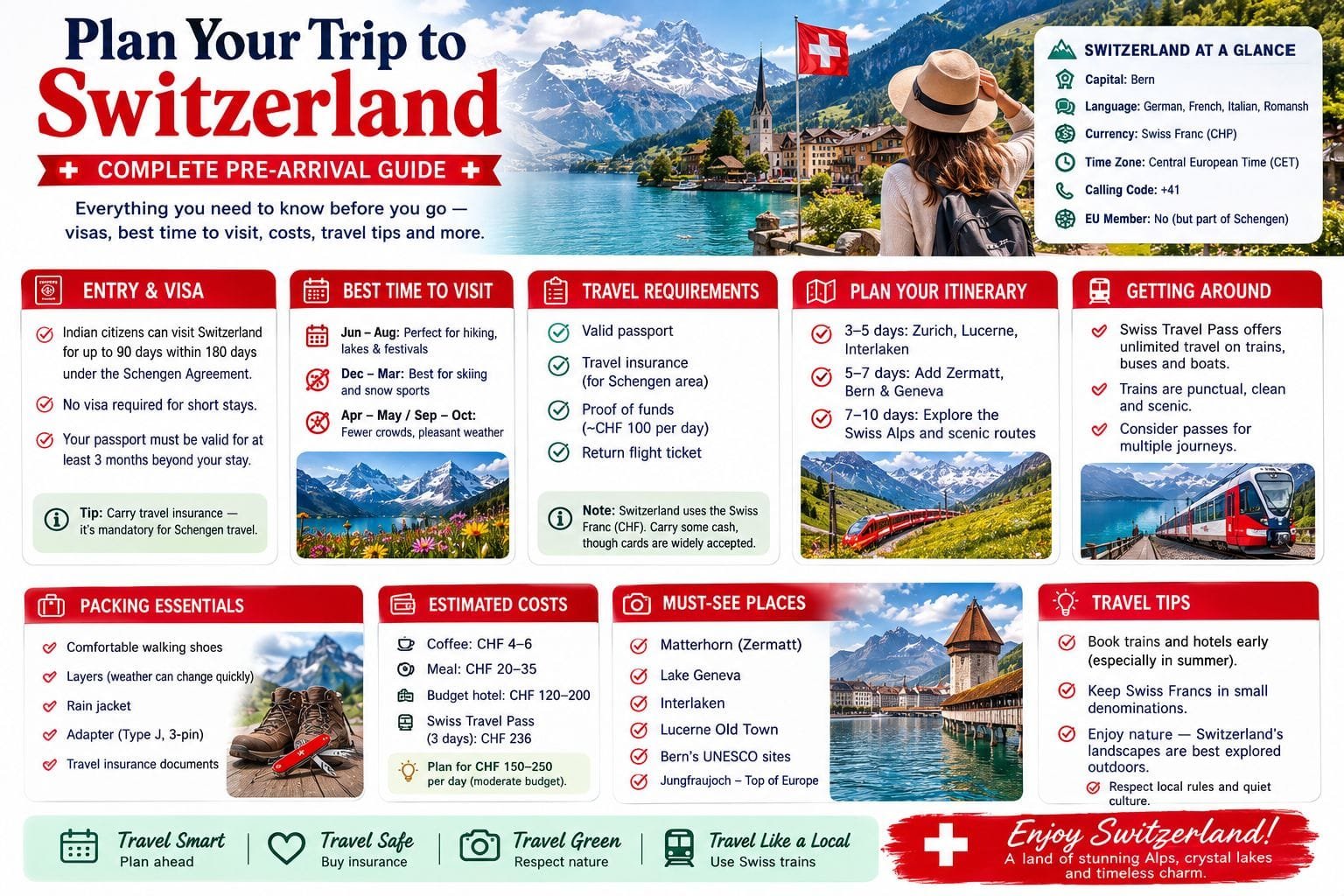
Planning a Switzerland trip rewards more effort than planning most destinations. The country is small enough that it is possible to plan exhaustively in advance, and expensive enough that good planning produces real savings: the right transport pass, the right season, the right accommodation strategy, and the right understanding of what costs what can make the difference of hundreds of francs on a typical visit.
This section covers every element of pre-trip preparation in the sequence that matters. Start with timing and budget; work through transport and visa; finish with packing and the specific itinerary frameworks that work for different trip lengths and interests.
The Central Question: Swiss Travel Pass or Point-to-Point Tickets?
Almost every Switzerland planning conversation eventually reaches this question, and the answer is more complicated than the Swiss Tourism marketing material suggests. The Swiss Travel Pass provides unlimited travel on SBB trains, PostBus routes, lake steamers, and some mountain railways; it also provides discounts on many other mountain railways and free entry to many museums. For visitors planning to travel extensively and visit multiple regions, it provides excellent value. For visitors staying primarily in one city, or making only two or three journeys, point-to-point tickets (especially discounted Supersaver fares booked in advance) are often cheaper.
The full analysis is in the Swiss Travel Pass guide, and working through it before making any transport bookings is the most financially consequential planning decision most visitors make. Do not buy the pass or skip it based on a general impression; run the calculation against your specific planned itinerary.
The Cost Reality
Switzerland is one of the most expensive countries in Europe for visitors from most Western countries. This is accurate, regularly verified, and should inform planning rather than deter it. The practical dimensions of Swiss costs:
Accommodation costs significantly more than equivalent quality in Germany, France, Italy, or Austria. A mid-range hotel double room costs CHF 180 to 300 in the major cities; budget options (hostel dorms) are CHF 40 to 80. Prices increase further in the ski resorts and the Jungfrau region during peak seasons.
Restaurant meals cost CHF 20 to 40 for a lunch main course at a standard sit-down restaurant; CHF 30 to 60 for a dinner main course at a good restaurant. The fixed-price lunch menu (Tagesmenu in German, menu du jour in French) is the budget visitor’s most important tool: most Swiss restaurants offer a two or three-course lunch menu at CHF 18 to 28 that represents the best value eating in the country.
Transport, as noted, is expensive without the right pass or advance fares; reasonable with them.
The Switzerland travel costs guide provides current price benchmarks for all major spending categories.
When to Book What
Switzerland’s accommodation and transport book up significantly during peak periods. The specific windows where advance booking is essential:
Major ski resorts (Zermatt, Verbier, Grindelwald, St Moritz) in the peak winter weeks: Christmas, New Year, and the Fasnacht (Carnival) period in February. Book accommodation months in advance for these periods.
The Jungfraujoch railway: the “Top of Europe” station at 3,454 metres is reached by a single rack railway that runs to capacity on summer days. From May to October a seat reservation on the final section is mandatory, so book ahead for July and August.
The Glacier Express: requires a seat reservation (CHF 54 per person in 2026, in both classes) on top of any ticket or rail pass, and the popular summer departures book weeks in advance.
Summer accommodation in Lucerne: the city is one of the most popular day-trip and overnight destinations in Switzerland, and waterfront hotels book up well in advance for July and August.
For everything else, Switzerland has enough accommodation supply that booking two to four weeks in advance is usually sufficient outside peak periods.
What Is in This Section
- Best time to visit Switzerland: month-by-month breakdown for all regions and activities
- Visa and entry requirements: who needs a visa and how to apply
- How many days in Switzerland?: frameworks for different trip lengths
- Packing for Switzerland by season: what to bring for the Alps, cities, and variable mountain weather
- Flights to Switzerland: airports, airlines, and how to find the best prices
- Is Switzerland worth the cost?: the honest answer to the honest question
- Switzerland itineraries: one week, two weeks, and the cities circuit
The Three Planning Principles That Reduce Swiss Trip Costs
Book accommodation outside the peak names: The Jungfraujoch has no overnight accommodation, so every visitor sleeps somewhere in the valleys below. Grindelwald is the quickest base: from Grindelwald Terminal, the Eiger Express cableway and the Jungfrau Railway reach the summit in about 45 minutes. Interlaken, a short train ride away, usually offers a wider range of budget options, including hostels. Staying in Visp or Brig rather than Zermatt and taking the train up saves a significant fraction of the Zermatt accommodation premium. The Swiss rail network makes this strategy practical.
Use the Tagesmenu for lunch: The fixed-price lunch menu at most Swiss restaurants provides a full meal at roughly half the cost of ordering from the dinner à la carte menu. Switzerland’s lunch culture is strong; many good restaurants that are expensive in the evening are entirely affordable at lunch.
Calculate the Swiss Travel Pass before buying it: For visitors making only a handful of significant rail journeys, point-to-point tickets can be significantly cheaper. SBB Supersaver tickets (Sparbillette / billets dégriffés), available on the SBB website and app, offer discounts of up to 50 percent, and up to 70 percent on selected trains. They are tied to a specific train and non-refundable, and availability is best off-peak and when booked early, which makes individual ticket booking competitive for straightforward itineraries.
Planning Switzerland with Limited Time
For visitors with 5 to 7 days and specific interests, the planning principle is depth over coverage. Switzerland’s major attractions are geographically concentrated enough that two or three days in the Jungfrau region, well-planned, produces a richer experience than five days trying to see Zürich, Lucerne, Interlaken, Zermatt, and Geneva in a single circuit.
The Jungfrau region specifically rewards staying in one place: Grindelwald or Mürren as a base, with day trips to the Jungfraujoch, the Bachalpsee, the Männlichen ridge, and the First gondola, produces four or five genuinely distinct experiences from a single overnight base. The alternative, moving accommodation every two days while trying to see the whole Swiss circuit, produces consistently shallower engagement with each place.
For visitors combining Switzerland with other European cities: arriving at Zürich airport and departing from Geneva airport (or vice versa) saves the return journey and opens the full German-speaking to French-speaking circuit without backtracking. Zürich in from the north, two to three days in the Alps, Geneva out to the west: a logical one-way progression that the Swiss Travel Pass makes economical.
What Switzerland Rewards
Switzerland rewards visitors who use the infrastructure that makes it distinctive: the train network, the mountain railways, the hiking trails, and the lake boats. Visitors who spend most of their Switzerland trip in city streets or in shopping areas are paying the Swiss price premium without accessing the Swiss value proposition. This is not a criticism; it is a practical observation. The city museums, the restaurant scene, and the urban culture of Zürich and Geneva are excellent; they are not, by themselves, why Switzerland costs what it costs.
The visitors who describe Switzerland as absolutely worth it are almost always the ones who took at least one day to use the mountain railway infrastructure and one day to walk on a marked trail above 1,500 metres. The visitors who describe it as overrated are often those who stayed at city hotel level throughout. Both groups paid the same prices; the difference was in how they used the access those prices bought.
Related: Destinations | Things To Do | Winter and Skiing | Practical Info | Expat and Nomad
Written by Laura Meier. Updated regularly as prices and conditions change. Corrections and updates are welcome at contact@allaboutswiss.com.