
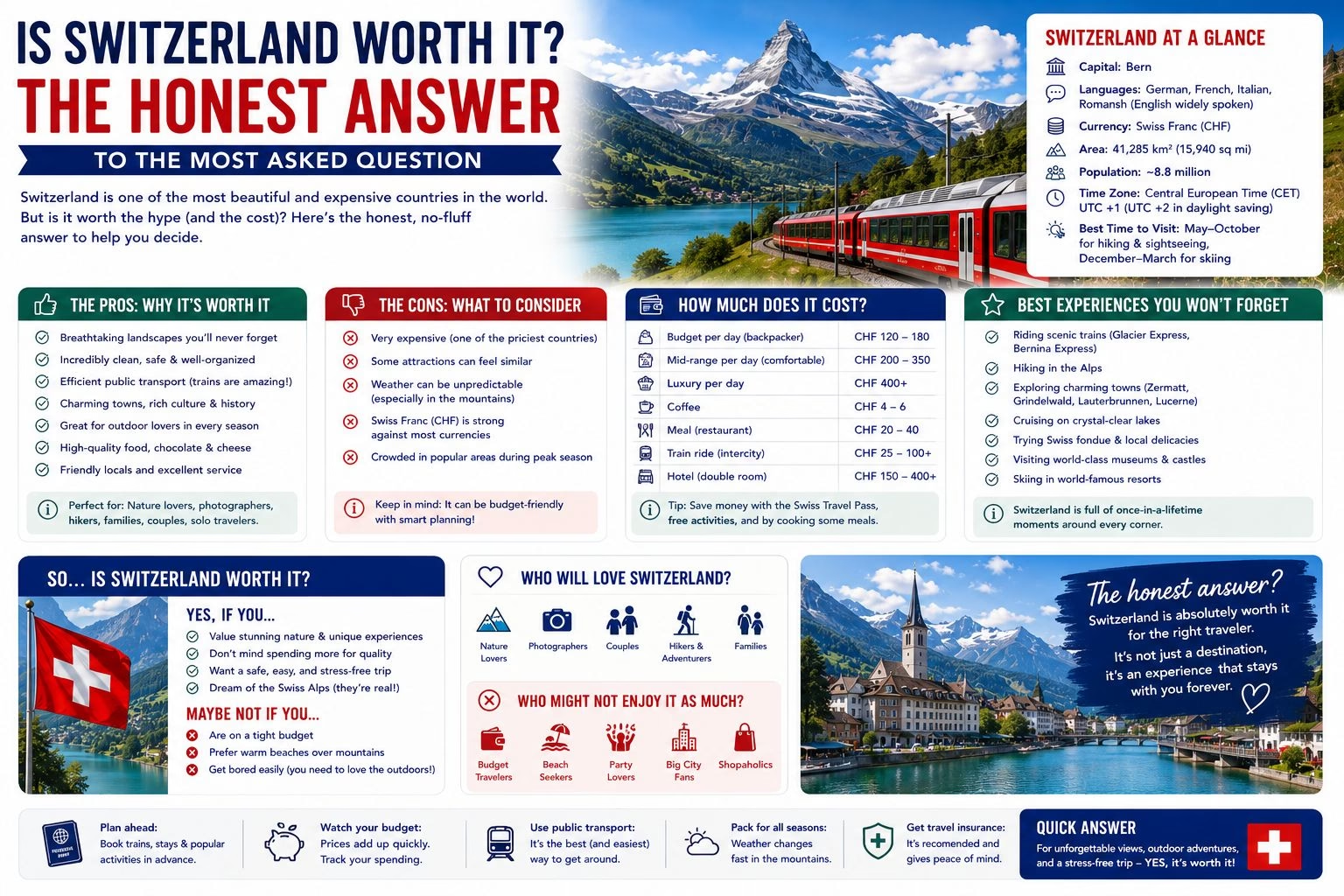
“Switzerland is beautiful but too expensive” is the most common sentence written about Swiss travel on any English-language forum. The question of whether Switzerland is worth its considerable cost is one of the most searched and most debated in European travel discussion, and it deserves an honest answer rather than a promotional one.
The honest answer: yes, for most visitors who arrive prepared, for specific reasons; no, or only marginally, for visitors who arrive unprepared for the costs and without a clear sense of what Switzerland specifically offers that its neighbours do not.
What Switzerland Is Worth Paying For
The hiking infrastructure: Switzerland has 65,000+ kilometres of marked and maintained hiking trails, a cable car and mountain railway network that provides access to high alpine terrain without technical mountaineering, and a trail-marking system so comprehensive that getting seriously lost on a marked path requires deliberate effort. The combination of accessibility and quality is available nowhere else in the Alps. France, Austria, and Italy all have magnificent mountain terrain; only Switzerland has the infrastructure to make it this accessible to ordinary visitors. This infrastructure is genuinely unique and genuinely worth the premium.
The train system: The SBB (Swiss Federal Railways) operates the most punctual, most comprehensive, and most scenically routed train network in Europe. The punctuality is real: Swiss trains are on time at a rate that makes British or Italian rail look like a comedy. The network reaches villages that would require a car in any other country. The scenic routes, particularly the Glacier Express, the Bernina Express, and the Goldenpass, are world-class travel experiences in their own right. For visitors who want to travel without a car, Switzerland’s train network provides a quality of experience that represents genuine value.
The alpine scenery combined with accessibility: You can eat a good lunch in Zürich and be standing at 3,000 metres above sea level looking at the Matterhorn within three hours, using only scheduled public transport. This combination of urban comfort and Alpine wilderness is the specific Switzerland value proposition.
Safety and reliability: Switzerland is extraordinarily safe, the infrastructure never fails to work, the water from every fountain is genuinely drinkable, and the overall quality and predictability of the travel experience is very high. For travellers who specifically value this reliability, Switzerland provides it.
City tourism without nature: If your Switzerland trip is primarily urban, Zürich and Geneva are beautiful but not significantly more beautiful than Vienna, Amsterdam, Lyon, or Florence, all of which cost 40 to 60 percent less for accommodation and food. The Swiss city premium is not justified by the city experience alone; it is justified by the Alpine access.
Beach or sun tourism: Switzerland is landlocked. The lake beaches are beautiful in summer but not tropical. Visitors seeking Mediterranean or coastal warmth get worse value in Switzerland than in neighbouring France, Italy, or Croatia.
Generic “nice European city” tourism: Switzerland’s value is specific; visitors who go because Switzerland is generally lovely and are happy with any nice European destination are paying a premium for an experience they could have more cheaply elsewhere.
Making Switzerland Worth It: The Practical Strategies
Research the Swiss Travel Pass seriously: The pass provides access to the specific experiences that justify the Swiss premium (scenic trains, mountain railways, lake steamers). Visitors who buy the right pass and use it to access the distinctive experiences get strong value; visitors who buy the pass to commute between two cities get mediocre value.
Use the Tagesmenu: Every decent Swiss restaurant offers a fixed-price weekday lunch menu at roughly half the dinner à la carte price. This is how Swiss workers eat, and it is genuinely good food. Eating one proper meal at Tagesmenu prices per day and supplementing with supermarket food cuts the food budget by 40 to 50 percent compared to eating à la carte every meal.
Stay in valley towns, not summit towns: Interlaken costs roughly 40 percent less per night than staying in Grindelwald, which costs roughly 30 percent less than staying in Mürren. You can access all of them from Interlaken by train. Zermatt accommodation costs roughly twice as much per night as accommodation in Visp or Brig at the bottom of the Zermatt rail line.
Visit in shoulder season: September and October produce the same alpine landscape, often better hiking conditions (trails dry, summer crowds gone), and accommodation prices 20 to 35 percent below July-August peaks in the main tourist areas.
The Comparison That Most Matters
The comparison is not Switzerland versus Italy or Switzerland versus France in general. It is Switzerland versus Austria or Slovenia for Alpine experiences specifically. Austria’s Tyrol and Vorarlberg, and Slovenia’s Triglav National Park and Julian Alps, offer world-class Alpine hiking and scenery at 30 to 50 percent lower costs across all categories.
The specific things that make Switzerland worth its premium over Alpine alternatives: the density and accessibility of the trail network, the quality and comprehensiveness of the public transport system, the specific scenic train experiences, and the combination of world-class cities with immediate Alpine access. If these specific attributes match what you want, Switzerland is worth it. If the Alpine experience is the primary draw and the specific Swiss infrastructure matters less, Austria or Slovenia provide comparable scenery at lower cost.
The Bottom Line
Switzerland is worth its premium for visitors who specifically use the infrastructure that justifies it: the hiking trails, the scenic trains, the mountain railways, the lakeside environments, and the specific combination of urban quality and Alpine access that is uniquely Swiss. For visitors who arrive without a clear plan to use these things, or who visit primarily for general European city tourism, the premium is harder to justify.
Come prepared. Know what you want to experience. Use the rail network. Eat the Tagesmenu. Spend the money on the mountain railways that connect you to the landscape rather than on the hotel upgrade in the tourist centre. Switzerland repays visitors who engage with it specifically rather than generically.
Related: Switzerland Travel Costs | Swiss Travel Pass | Plan Your Trip | Best Time to Visit
Written by Laura Meier. Updated regularly as prices and conditions change. Corrections and updates are welcome at contact@allaboutswiss.com.