
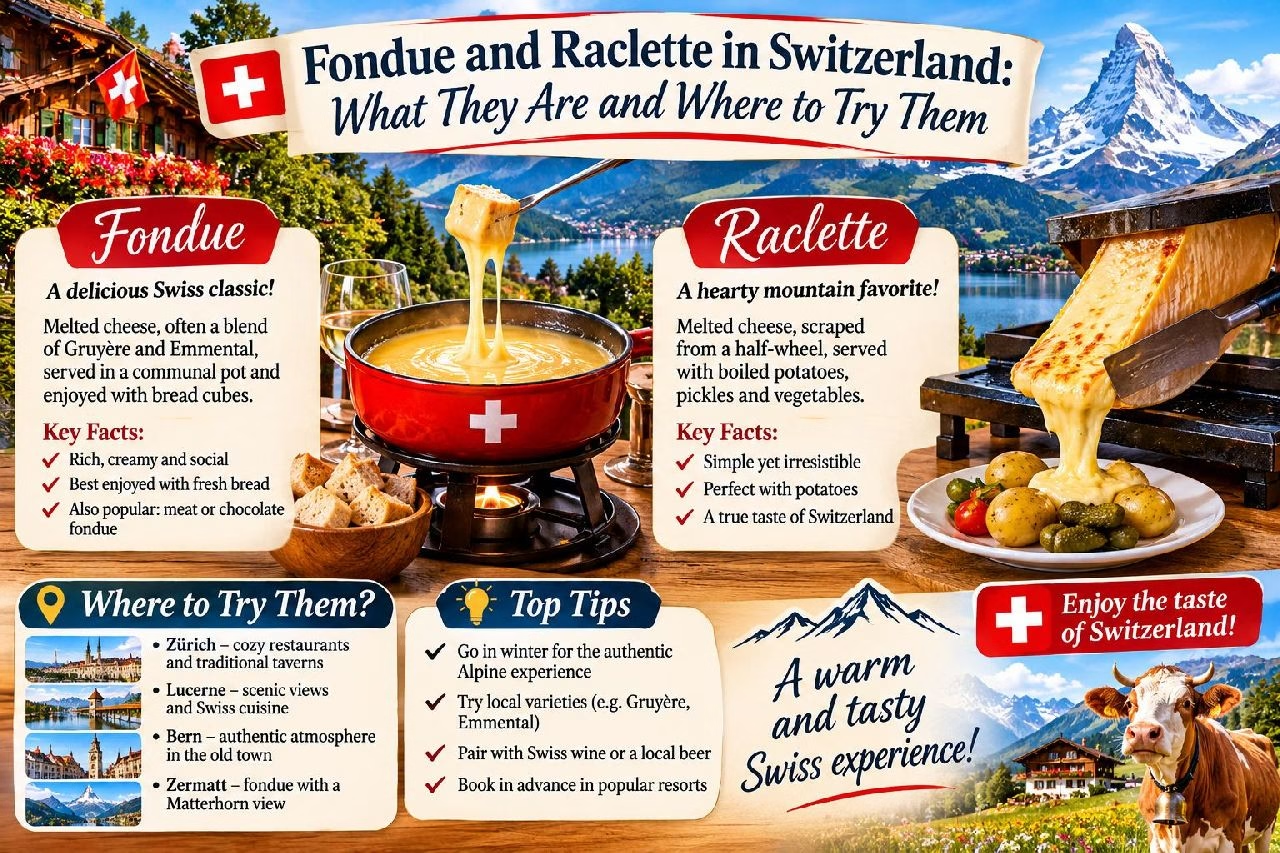
Fondue and raclette are the two cheese dishes most visitors want to try in Switzerland. They are different dishes with different customs. Menus and prices vary by restaurant, so check before you book.
Both are simple to describe and surprisingly easy to get wrong when you are ordering for the first time. How many portions do you need, what should you drink with them, and where do you find a good version that is not a tourist trap? This guide explains how each dish works, the customs that go with them, how to order without overspending, and where to look for the real thing.
| Fondue | Raclette | |
|---|---|---|
| What it is | Melted cheese in a shared pot | Cheese melted and scraped onto your plate |
| How you eat it | Dip bread on long forks | Pour it over potatoes, with pickles |
| Cheese | A blend, often with white wine | A single raclette cheese |
| Associated with | Western Switzerland and the whole country | The canton of Valais |
| Feels like | A shared, slow, social meal | Portion by portion, at your own pace |
Fondue
Fondue is melted cheese, usually a blend of Swiss cheeses and white wine, served in a shared pot over a flame. You dip cubes of bread on long forks. If your bread falls into the pot, local custom has a playful forfeit. Many restaurants offer variations with different cheeses or tomato and mushroom additions.
The classic recipe uses Gruyère and often another cheese such as Vacherin Fribourgeois, sometimes in an equal mix known as moitié-moitié. The cheese is melted with white wine and a little garlic and thickened with a touch of starch, and many cooks add a splash of kirsch. The pot sits over a small burner at the table, and the cheese needs a gentle flame and occasional stirring, often in a figure-of-eight, to stay smooth. At the end, the crust that forms on the bottom of the pot is a prized treat, and it is usually shared.
What comes with fondue
- Cubes of bread, usually with a crust, so that they stay on the fork.
- Pickled gherkins and small pickled onions, which cut through the richness.
- Boiled potatoes, dried meats or a green salad, often as extras that cost more.
You may also see other dishes with the fondue name on menus, such as meat cooked at the table in hot broth or oil, and chocolate fondue for dessert. These are separate dishes, so check which one you are ordering.
Raclette
Raclette is a cheese that is melted and scraped over boiled potatoes, usually with pickles and small onions. It is especially associated with Valais. At restaurants it is often served in a series of portions, and at markets you can find it served directly from the melted wheel.
The name comes from a French word meaning to scrape. A half wheel of cheese is held close to a heat source, and when the surface bubbles, it is scraped onto your plate. You eat it with small boiled potatoes, pickles and pickled onions, sometimes with dried meat, and a grind of pepper or a sprinkle of paprika. In some restaurants a table grill with small pans lets you melt your own slices, which makes it a more hands-on meal. Raclette is served portion by portion, so you can start with one or two and order more, which is easier to pace than a pot of fondue.
When and how to eat them
- Both are mostly cold-season dishes, but some restaurants serve them year round.
- Fondue is typically ordered for two or more people, so single diners should ask for a portion for one.
- Local habit favours tea, white wine or kirsch with fondue, rather than cold drinks.
Customs and manners
- Spear the bread, dip it, swirl it and put it on your plate before you eat it, instead of eating straight from the long fork.
- Keep the flame low, and stir the pot now and then so that the cheese does not catch.
- If you lose your bread in the pot, expect some friendly teasing, and perhaps a forfeit.
- Take your time. Both dishes are meant to be eaten slowly, and a meal can last a couple of hours.
The tradition of avoiding cold drinks with fondue comes from a belief that they make the cheese sit heavily in the stomach. Not everyone follows it, but a hot tea or a glass of white wine is the classic choice, and a small kirsch often ends the meal. Both dishes are rich, so keep the rest of the day light, and avoid planning a long walk or a mountain trip straight afterwards.
Where to try them
- Traditional restaurants and village inns: The most reliable choice, particularly in Western Switzerland and in cheese-making regions.
- Mountain huts and restaurants: A fondue or raclette after a walk or a day on the slopes is a classic, and many serve it in the colder months. See our mountain excursions guide for ideas on where to go.
- Markets and winter markets: Raclette served straight from the wheel is easy to find at stalls in colder months, and it is a quick, cheaper way to try it.
- Cheese dairies: Some show dairies and farm shops serve cheese dishes and let you see how the cheese is made.
- Novelty fondue: Some places offer fondue in unusual settings, such as a cable car cabin or an igloo. These can be fun but are usually expensive, so treat them as an experience rather than a typical meal.
Ordering well
Fondue is usually priced per person for a minimum of two, so check whether the price on the menu is per person or per pot. Extras such as potatoes, dried meat and extra bread may cost more. If you are dining alone, ask whether a single portion is available, or choose raclette, which is served by the portion. Water and soft drinks can add up in Swiss restaurants, so check the drinks list, and note that service is included in the price, so rounding up the bill is enough. Booking is sensible for evenings and weekends in winter, and for mountain restaurants in busy periods.
Dietary notes
- Cheese fondue is vegetarian, but it normally contains wine and often a little kirsch, and the bread contains gluten. Ask the restaurant about alcohol-free or gluten-free options.
- Neither dish is suitable for vegans.
- Some cheeses are made from raw milk. If you are pregnant or have a weakened immune system, ask your doctor which cheeses are suitable for you.
Other cheese dishes to look for
If you like fondue and raclette, look out for other Swiss dishes built around cheese. Alpine macaroni, made with pasta, potatoes, cheese and onions and served with apple sauce, is a hearty mountain dish. Cheese on toast, fried cheese balls and rösti topped with cheese are common on traditional menus, and regional cheeses such as those from Appenzell, Gruyères and Emmental are often sold in local shops and dairies.
Taking it home
Ready-made fondue mixes and raclette cheese are sold in supermarkets and cheese shops, and make easy souvenirs. Check the rules for bringing dairy products into your home country before you pack them, since some countries restrict them. Pack cheese in a cool bag if you are travelling in warm weather.
Budget
These dishes can be pricey in tourist areas, so compare menus. See our travel costs guide and the Food and Drink hub.
To spend less, share a pot of fondue between two people, choose a restaurant a street or two away from the main tourist squares, order raclette by the portion at a market stall or look for a lunchtime special. Cooking at home is cheaper still, since supermarket fondue mixes are good value, so consider this if you are staying in an apartment.
Fondue and raclette FAQ
What is the difference between fondue and raclette?
Fondue is a pot of melted cheese that you dip bread into, while raclette is melted cheese scraped over potatoes, with pickles. Fondue is shared, and raclette is served by the portion.
Can I eat fondue alone?
Sometimes, if a restaurant offers a single portion. If not, order raclette, which is easy to eat by yourself.
Is fondue only a winter dish?
It is mostly eaten in the colder months, but many restaurants serve it all year, especially in tourist areas.
What should I drink with fondue?
Tea, white wine or a small kirsch are the traditional choices, and cold drinks are generally avoided.
Is it vegetarian?
Cheese fondue and raclette are vegetarian, but they normally contain alcohol, and some accompaniments include meat, so check when you order.
Keep planning
You may also like our Food and Drink hub, our travel costs guide and our mountain excursions guide.

I’m Laura, a travel writer based in Zürich, and Switzerland is the place I know better than anywhere else. I moved here 9 years ago and haven’t stopped exploring it since.
Over the past 9 years I’ve made 40+ trips across every Swiss canton — from the Italian-speaking south of Ticino to the remote valleys of Graubünden to the lake towns of Romandy. I speak German, French and English fluently, which means I can read the local newspapers, argue with train conductors, and actually understand what the mountain guide is telling you when the weather turns.
Switzerland is a deceptively complex destination: four languages, 26 cantons, wildly different regional cultures, and a transport network so intricate it takes years to properly understand. I write to demystify all of it — whether you’re planning your first visit to Zermatt, deciding between Zürich and Geneva for a city break, or figuring out how to live here as a digital nomad or remote worker.
I also cover Central Europe for travellers who want to venture beyond the obvious — particularly the Czech Republic, Austria and the Alpine arc connecting Switzerland to its neighbours.
All About Swiss is my home base, where I publish in-depth guides to Swiss travel, life and culture. If it involves Switzerland, I’ve probably written about it, or I’m about to.