
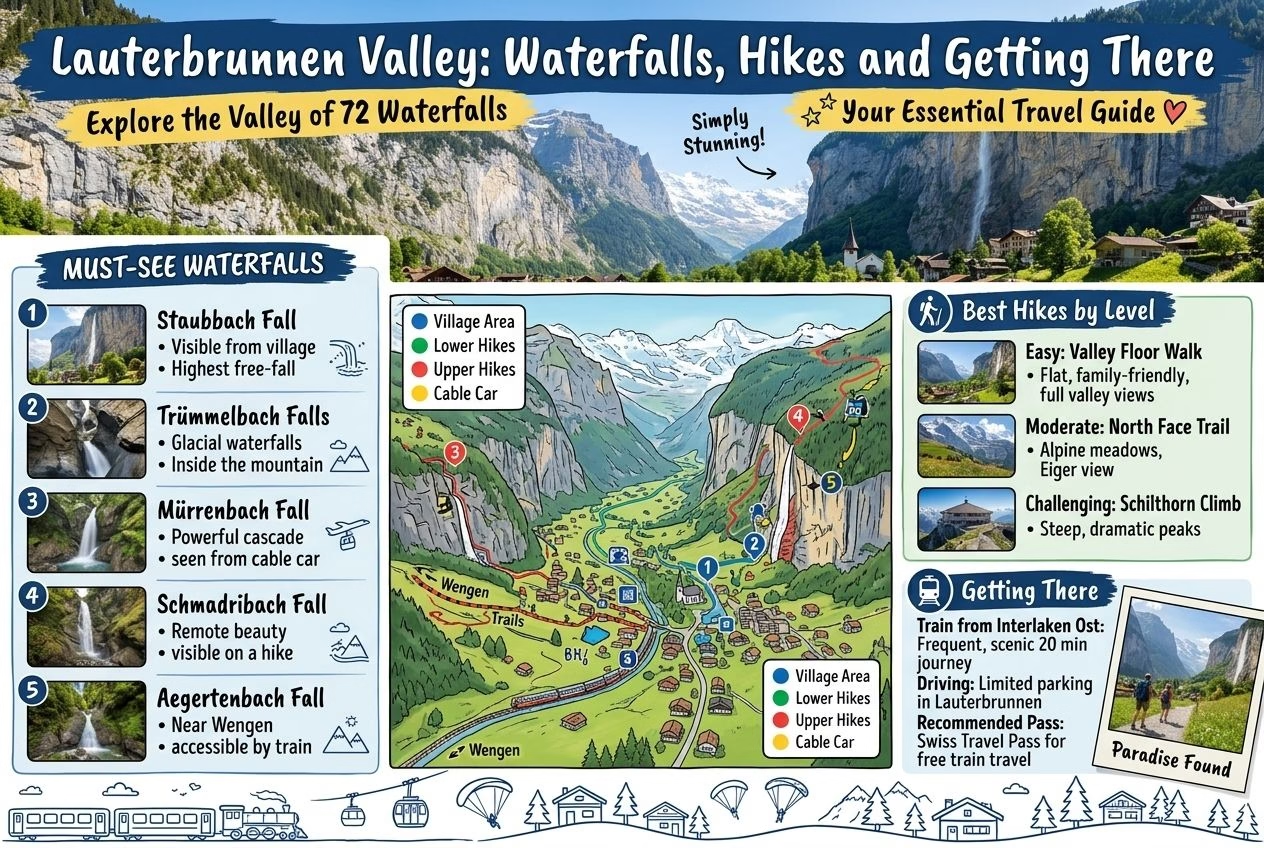
Lauterbrunnen is a steep-sided valley in the Bernese Oberland with dozens of waterfalls and cliff-top villages. It is easy to reach from Interlaken and works as a base or as a half-day stop. Operating times and conditions change, so check locally.
The valley is a deep, glacier-carved trough with sheer rock walls on both sides, and water spills from the cliffs in thin ribbons almost everywhere you look. It is often quoted as having 72 waterfalls, and the best known, the Staubbach Falls, drops close to 300 metres right beside the village. The valley is also said to have inspired a famous writer’s vision of an elven refuge, and it has the kind of scenery that makes people stop and stare. This guide covers how to get there, what to do on the valley floor and above it, where to stay, and how to combine the valley with other excursions in the Jungfrau region.
Getting there
A regular train runs from Interlaken Ost to Lauterbrunnen in under half an hour. From there, mountain railways and cable cars lead to Wengen, Mürren and other higher points.
Trains are frequent through the day, and the scenic ride up the valley is part of the experience, so sit on the side with the best views of the cliffs. A local bus continues from Lauterbrunnen to Stechelberg at the head of the valley, passing the turn-off for the Trümmelbach Falls. If you drive, there is parking at Lauterbrunnen and further up the valley, but spaces can fill early in summer, and the train is usually simpler. Check current timetables and pass conditions before you go. See our SBB train guide for tickets.
What to do
- Walk the valley floor to Staubbach Falls and beyond.
- Visit Trümmelbach Falls, a series of glacier-fed waterfalls inside the mountain, usually seasonal.
- Take a mountain train to Wengen or Mürren for views across the valley.
The valley floor
The flat path from Lauterbrunnen to Stechelberg is one of the easiest and most rewarding walks in the region. It follows the river through meadows and past farms, with waterfalls dropping from the cliffs on both sides, and takes a couple of hours at a relaxed pace. You can walk one way and return by bus. Staubbach Falls is right at the edge of the village, and a path leads up beside it for a closer look, though the way is steep and can be wet and slippery. On a sunny day the spray often produces rainbows.
Trümmelbach Falls
The Trümmelbach is a glacier-fed stream that crashes through a series of waterfalls hidden inside the mountain. Tunnels, stairs and walkways lead you through the gorge, close to the thundering water, and the roar is loud. It is open mainly in the warmer months, and the volume of water is greatest in early summer, when snow and ice are melting. Wear a waterproof layer and shoes with grip, since the walkways are wet, and expect spray. Check the opening dates and conditions before you set out, since it closes in winter and in some weather.
Above the valley
- Wengen: A car-free village on a terrace above the valley, reached by a rack railway. It is a good base for walks and for the panorama trail between Männlichen and Kleine Scheidegg, with views of the Eiger, Mönch and Jungfrau.
- Mürren and Gimmelwald: Two small villages on the opposite side of the valley, reached by cable car, with sweeping views and quiet paths. See our Schilthorn and Mürren guide.
- Stechelberg: The end of the valley, where the Schilthorn cable car begins and several walks start.
Other activities
The valley is a famous spot for BASE jumping and paragliding, so you may see people jumping from the cliffs. They are experienced, so admire from a distance and keep clear of landing areas. Other options include cycling on the valley road, guided canyoning and in winter, sledging and snowshoeing around the higher villages. In winter, the steep walls block the sun for much of the day, so the valley floor can feel cold and shaded.
Where to stay
| Base | Good for | Keep in mind |
|---|---|---|
| Lauterbrunnen village | Waterfalls on your doorstep, easy trains and buses | Shaded in winter, and busy in summer |
| Wengen | A car-free resort village, ski access and panorama walks | More expensive, and reached by rack railway |
| Mürren | Views, quiet and the Schilthorn | Reached by cable car, and luggage handling takes planning |
| Gimmelwald | A tiny, traditional village and budget stays | Very limited services, and cable car access only |
| Interlaken | More choice, restaurants and transport links | You travel to the valley each day |
Lauterbrunnen has hostels, campsites, guesthouses and a few hotels, and it fills up quickly in summer, so book early. Wengen and Mürren are more upmarket, and Gimmelwald is small and simple. If you plan to visit several excursions in the region, a base in the valley saves time compared with returning to Interlaken each day. Our Interlaken travel guide covers the alternative.
Sample plans
Half a day from Interlaken. Take an early train to Lauterbrunnen, walk to the Staubbach Falls, then take the bus or walk to the Trümmelbach Falls for the gorge, and return in the afternoon.
A full day on the valley floor. Walk from Lauterbrunnen to Stechelberg, visit the falls on the way, have lunch at a village inn and return by bus or train.
A day above the valley. Take the rack railway to Wengen, ride up to Männlichen, walk the panorama trail to Kleine Scheidegg and return by train to Lauterbrunnen. Choose a clear day for this one.
Two or three days. Combine the valley floor with a village night in Mürren or Wengen and an excursion to the Schilthorn or Jungfraujoch, keeping a spare day for weather.
When to go
Late spring and early summer bring the most powerful waterfalls from snowmelt, while summer is the best time for high trails. Autumn is calm and colourful, and winter is quiet, with sledging and skiing in the higher villages, though some attractions are closed. Rain makes the waterfalls dramatic but the paths slippery, so wear good shoes. Check the forecast, since the valley can be shaded or misty on days when the peaks are clear. Our guide to mountain weather explains how to read the conditions.
Practical tips
- Wear shoes with grip and bring a waterproof layer, since paths near the falls are wet.
- Stay on marked paths, and respect farmland, fences and livestock.
- Do not swim in the glacial streams and rivers, which are very cold and fast.
- Check the last trains, buses and cable cars before you set out.
- Carry some cash and snacks, since shops and cafes in the higher villages can be limited.
- Download offline maps, since coverage can be patchy in the side valleys. See our guide to SIM cards, eSIMs and mobile data in Switzerland.
For safety advice on trails and weather, see our mountain safety guide. In an emergency, 112 is the general emergency number, 144 calls an ambulance and 1414 reaches the Swiss air rescue service.
Combine with
See Jungfraujoch, Schilthorn and Mürren and the Jungfrau region hiking guide. Check mountain weather before you go.
Lauterbrunnen FAQ
Is Lauterbrunnen worth visiting?
Yes. It is one of the most scenic valleys in Switzerland, easy to reach and free to enjoy, with plenty of walks and no ticket needed for the main sights.
How long do I need?
Half a day covers the waterfalls and the valley floor from Interlaken. A night or two lets you add a village above the valley or a major excursion.
Do I need a car?
No. Trains, buses and cable cars cover the valley and the villages, and parking can be limited in summer.
Are the Trümmelbach Falls worth it?
Many visitors enjoy them, especially in the warmer months when the water is strongest. They involve an entry fee, wet walkways and many steps, so check opening times and your own comfort level.
Is the valley suitable for children?
Yes. The valley floor path is flat and easy. Keep a close eye on children near rivers, falls and steep drops.
Keep planning
You may also like our Interlaken travel guide, our Swiss Travel Pass guide and our SBB train guide.

I’m Laura, a travel writer based in Zürich, and Switzerland is the place I know better than anywhere else. I moved here 9 years ago and haven’t stopped exploring it since.
Over the past 9 years I’ve made 40+ trips across every Swiss canton — from the Italian-speaking south of Ticino to the remote valleys of Graubünden to the lake towns of Romandy. I speak German, French and English fluently, which means I can read the local newspapers, argue with train conductors, and actually understand what the mountain guide is telling you when the weather turns.
Switzerland is a deceptively complex destination: four languages, 26 cantons, wildly different regional cultures, and a transport network so intricate it takes years to properly understand. I write to demystify all of it — whether you’re planning your first visit to Zermatt, deciding between Zürich and Geneva for a city break, or figuring out how to live here as a digital nomad or remote worker.
I also cover Central Europe for travellers who want to venture beyond the obvious — particularly the Czech Republic, Austria and the Alpine arc connecting Switzerland to its neighbours.
All About Swiss is my home base, where I publish in-depth guides to Swiss travel, life and culture. If it involves Switzerland, I’ve probably written about it, or I’m about to.