
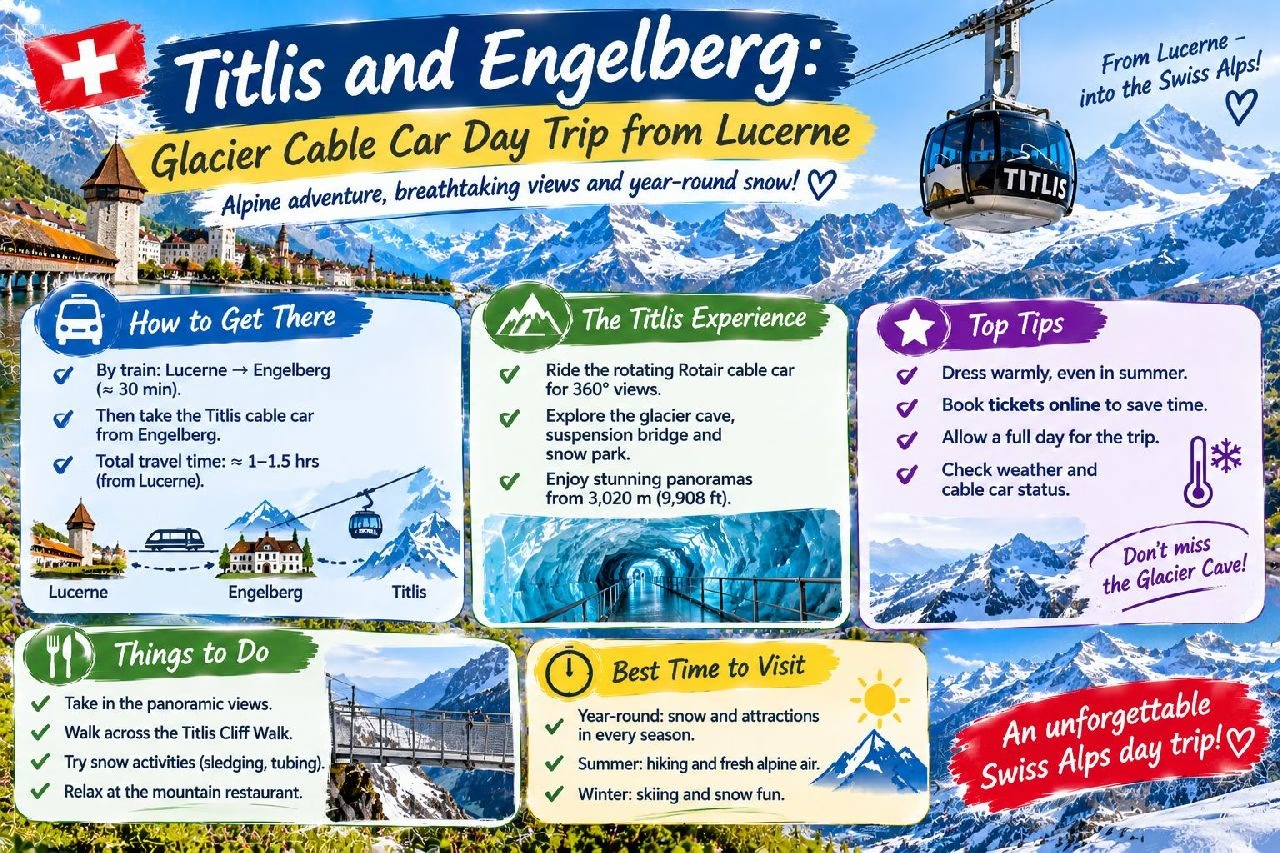
Mount Titlis is the main mountain above Engelberg and an easy day trip from Lucerne. Cable cars, including a rotating gondola, lead to a glacier area at the top. Operating times and prices change, so confirm them on the operator’s site.
At about 3,200 metres, the summit area gives you a taste of the high Alps without the long journey of some other excursions. The village of Engelberg lies in a green valley south of Lucerne, and the cable car climbs from there in several stages to snow, ice and long views. It is a good choice if you want a glacier experience in a single day from central Switzerland. This guide explains how the journey works, what to see, how to handle the weather and altitude, and how Titlis compares with other mountain trips.
Getting there
Take the train from Lucerne to Engelberg, which takes under an hour, then walk or take a short bus to the valley cable car station. See our SBB train guide for tickets.
Trains between Lucerne and Engelberg run frequently through the day, and the line climbs through a pretty valley as it approaches the village. From the station, the valley cable car station is a short walk through the village, and a local bus is available if you prefer to ride. Check the first and last departures from both ends, and allow extra time on busy weekends and holidays, when the queues at the valley station can be long.
How long does the day take?
Plan for most of a day. The train takes under an hour each way, the cable car stages take around an hour to the top, and most visitors spend two to three hours on the glacier, so a full round trip from Lucerne takes roughly seven to nine hours including waits. An early start gives you the best chance of clear skies and the shortest queues.
What to expect
- Several cable car stages to the glacier area.
- A glacier cave and a suspension bridge, which may be closed in strong wind or poor weather.
- Snow even in summer, so bring warm clothes and sturdy shoes.
The journey up
The ascent is part of the fun. The first stages take you above the village to a mountain lake and an alpine plateau, where you can stop for a walk on the way up or down. The upper stages climb steeply above the tree line, and the final stage uses a rotating gondola, so you turn slowly through a full circle as you rise over the glacier. Seats are limited, and you get the best views from the sides, so be patient and move around the cabin.
At the top
- The glacier cave: A tunnel cut into the ice, glowing blue, and cold and slippery underfoot. Wear shoes with grip.
- The suspension bridge: A narrow footbridge high above the glacier, one of the highest in Europe. It closes in wind, ice or low cloud, and is not for anyone with a fear of heights.
- The viewing terraces: Platforms with panoramas of peaks and glaciers on clear days.
- Snow activities: A glacier park with a chairlift and snow activities, which is especially popular with families in summer.
- Restaurants and a gift shop: Food at the summit is expensive, so many visitors bring snacks.
Not every attraction is open every day. Wind, snow and low cloud can close the bridge, the chairlift and some outdoor areas, so check the operator’s notices on the day and do not count on seeing everything.
Tips
Go early and check the weather before leaving Lucerne. If the summit is cloudy, consider a lake cruise or another mountain such as Rigi instead. Read our mountain excursions guide and the Lucerne page.
- Check the live webcams at the top and the forecast the evening before and again in the morning.
- Bring warm layers, a windproof jacket, a hat and gloves, since temperatures at the top are often around freezing, even in summer.
- Wear shoes with good grip, and bring sunglasses and strong sun protection, since the glare from the snow is intense.
- Check the time of the last cable car down before you linger.
- Carry some water and a snack, and a power bank, since cold drains batteries quickly.
Weather and altitude
The weather at the top can be very different from Lucerne. A sunny morning in the valley does not guarantee a clear summit, and a grey day below can sometimes mean sun above the cloud. The webcams are more useful than a general forecast, and mornings are often clearer than afternoons. At more than 3,000 metres, some people feel breathless, dizzy or tired, especially after the quick ascent. Move slowly, drink water, avoid heavy meals and alcohol, and go back down if you feel unwell. People with heart or lung conditions, pregnant visitors and parents of young children should ask a doctor before they go.
Tickets and passes
Titlis is a premium excursion, but it is usually cheaper than the Jungfraujoch. Swiss passes often give a discount on the mountain section rather than free travel, and some combination tickets cover the train from Lucerne. Compare the total with and without your pass before you buy, and look for any early-morning or off-peak options. Our Swiss Travel Pass guide explains how passes work.
Seasons
Titlis is open for much of the year, but the experience changes with the seasons. In summer you can combine the glacier with a walk around the mountain lake on the way. In autumn the air is often crisp and clear, with fewer crowds. In winter the mountain is a ski area, so the cable cars carry skiers and snowboarders, the weather is harsher and some summer attractions are closed. There is usually a closure for maintenance in part of the off-season, so check the dates before you plan a trip in spring or late autumn.
With children
Titlis suits families, and the rotating gondola and snow activities are popular with children. Dress them warmly, since it is much colder at the top than in the valley, watch for altitude symptoms, and keep a close eye on them near the bridge and the glacier edges. The mountain lake on the way up is a good stop for a play and a picnic.
Titlis compared with other trips
| Titlis | Jungfraujoch | Schilthorn | |
|---|---|---|---|
| Base | Lucerne and Engelberg | Interlaken and Grindelwald | Lauterbrunnen and Mürren |
| Altitude | About 3,200 metres | About 3,450 metres | Just under 3,000 metres |
| Journey from base | Shorter | Longer | Medium |
| Highlights | Rotating gondola, glacier cave, suspension bridge | Ice tunnels and the longest glacier in the Alps | Revolving restaurant, villages and views of the three peaks |
If you are based in Lucerne and want a glacier day without moving hotel, Titlis is the simplest choice. If you are heading to the Bernese Oberland, read our guides to Jungfraujoch and Schilthorn and Mürren to compare.
If the weather is poor
Lucerne has plenty of fallback options. A lake cruise, a visit to the old town and its covered bridge or a trip up Rigi on a clearer day all make a good day out. In Engelberg itself, the abbey and its show dairy are worth a visit, and a walk beside the river is pleasant when the mountain is in cloud.
Titlis FAQ
Is Titlis worth it?
In good weather, yes. The ride, the glacier and the views make for an easy and memorable day trip from Lucerne. In cloud, you will see much less, so check the webcams first.
How long does it take from Lucerne?
The train to Engelberg takes under an hour, and the full day usually takes seven to nine hours with time at the top.
Do I need to book in advance?
Not always, but it can help in peak season or at weekends. Check the operator’s booking options, and keep some flexibility for the weather.
Can I use my Swiss Travel Pass?
Passes often give a discount on the mountain section. Check the current conditions before you buy.
Is the suspension bridge always open?
No. It can close in strong wind, snow or poor visibility, so do not plan the trip around it.
Is it suitable for people with mobility needs?
The cable cars are accessible in many parts, but snow, ice, steps and the narrow bridge can be difficult. Contact the operator in advance to ask about the current arrangements.
Keep planning
You may also like our mountain excursions guide, our Lucerne page, our SBB train guide and our Jungfraujoch guide.

I’m Laura, a travel writer based in Zürich, and Switzerland is the place I know better than anywhere else. I moved here 9 years ago and haven’t stopped exploring it since.
Over the past 9 years I’ve made 40+ trips across every Swiss canton — from the Italian-speaking south of Ticino to the remote valleys of Graubünden to the lake towns of Romandy. I speak German, French and English fluently, which means I can read the local newspapers, argue with train conductors, and actually understand what the mountain guide is telling you when the weather turns.
Switzerland is a deceptively complex destination: four languages, 26 cantons, wildly different regional cultures, and a transport network so intricate it takes years to properly understand. I write to demystify all of it — whether you’re planning your first visit to Zermatt, deciding between Zürich and Geneva for a city break, or figuring out how to live here as a digital nomad or remote worker.
I also cover Central Europe for travellers who want to venture beyond the obvious — particularly the Czech Republic, Austria and the Alpine arc connecting Switzerland to its neighbours.
All About Swiss is my home base, where I publish in-depth guides to Swiss travel, life and culture. If it involves Switzerland, I’ve probably written about it, or I’m about to.