
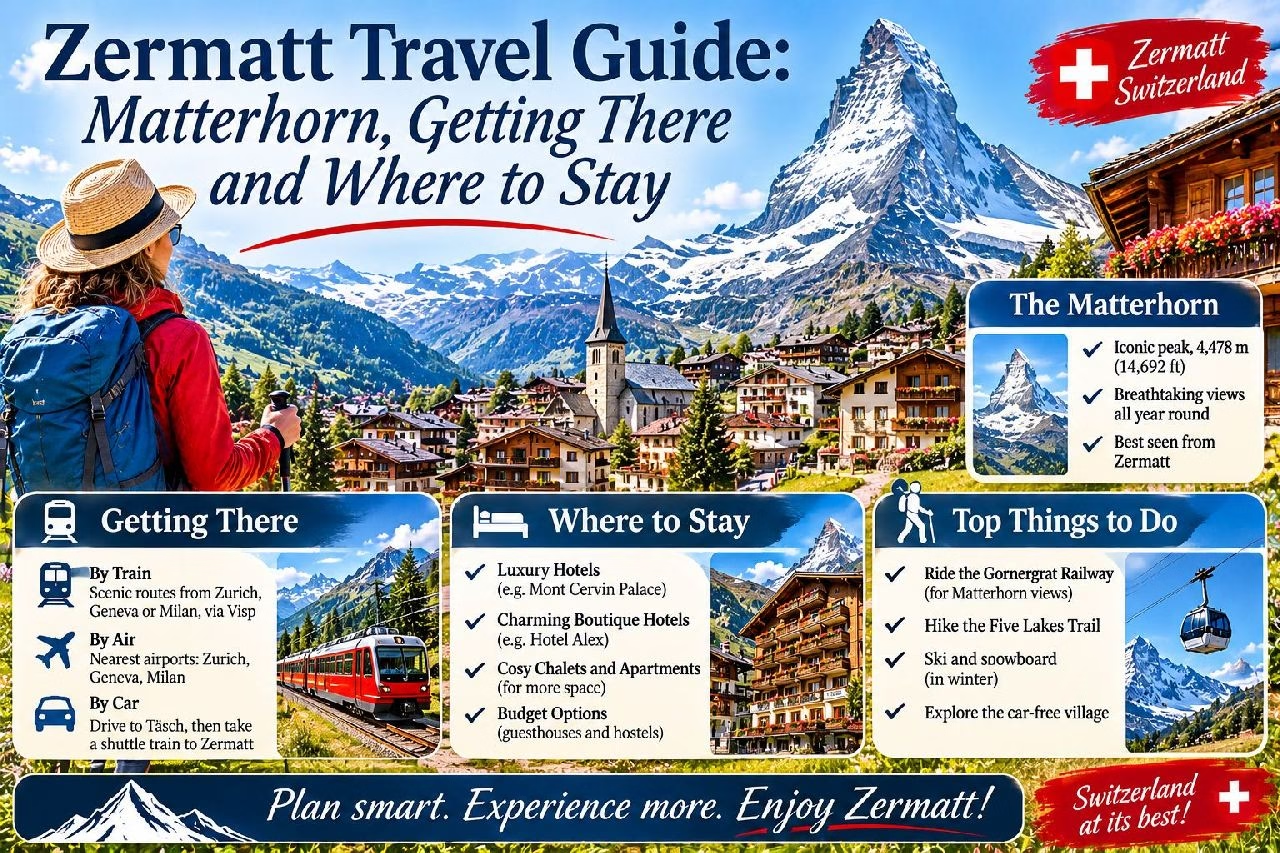
Zermatt is a car-free mountain village at the foot of the Matterhorn. It is a destination in both summer and winter, with hiking, viewpoints and one of the largest ski areas in Switzerland. Prices, schedules and conditions change, so check current details before you book.
The Matterhorn, at about 4,478 metres, is the most recognisable mountain in the Alps, and Zermatt sits at around 1,600 metres in its shadow. The village is small and lively, with wooden chalets, narrow lanes, electric taxis in place of cars and a long list of cable cars, railways and trails that lead up in every direction. It is expensive and busy in high season, but it is also one of the most rewarding places in Switzerland to spend a few days. This guide covers how to get there, what to do in each season, where to stay and how to plan around the weather.
Getting there
Cars stop in Täsch, and a shuttle train continues to Zermatt. From most Swiss cities the journey involves a change in Visp. See our SBB guide.
In practice, the journey has two stages. The main-line train takes you to Visp, and a mountain railway then climbs the valley to Zermatt, which takes roughly an hour. Journeys from cities such as Bern, Lausanne and Zürich usually take several hours in total, so plan to arrive with time to spare. If you drive, you park at a terminal in Täsch and take the shuttle train for the last stretch, which is short and frequent. Zermatt is also a stop on the scenic Glacier Express, which links it with St. Moritz on a long journey through the Alps.
Can you visit Zermatt as a day trip?
It is possible from some cities, but the travel time is long, and you will have only a few hours in the village. A night or two is much better, particularly if you want to catch the Matterhorn in clear morning light.
Getting around the village
The village is compact and easy to walk. Small electric taxis and buses operate for luggage and longer distances, and most lifts and railways start within a short walk of the station. Wear comfortable shoes with grip, since the lanes can be steep and icy in winter.
What to do
- Ride the Gornergrat railway for Matterhorn views.
- Walk the trails around the village. See the Zermatt and Matterhorn hiking guide.
- Ski or snowboard in winter. See the Zermatt skiing guide.
The big viewpoints
- Gornergrat: A cogwheel railway climbs to just over 3,000 metres, with a wide panorama of the Matterhorn, Monte Rosa and the glaciers. It is the classic first excursion. Walking down part of the way is a popular option.
- Riffelsee: A small lake on the Gornergrat route, famous for the mirror-like reflection of the Matterhorn on calm mornings.
- Sunnegga, Blauherd and Rothorn: An underground funicular and cable cars lead to a different set of viewpoints and to a well-known lake walk that passes several mountain lakes.
- Matterhorn Glacier Paradise: A high cable car to the Klein Matterhorn, one of the highest cable car stations in Europe, with an ice palace and views reaching into Italy and France. At nearly 3,900 metres, altitude symptoms are more likely, so take it slowly.
In the village
The Matterhorn Museum tells the story of the first ascent in 1865, a triumph that ended in tragedy on the way down, and the history of the village. The Gorner Gorge, a short walk from the centre, is a good wet-weather outing. A stroll through the old quarter, with its dark timber barns and houses, is a quiet contrast to the main street.
Climbing the Matterhorn
Climbing the Matterhorn is a serious mountaineering undertaking and not a hike. It needs experience, fitness, equipment and normally a licensed mountain guide, and the route can be dangerous in poor conditions. If you are a visitor who wants to see the mountain, the viewpoints above are the right choice. If you are an experienced climber, make arrangements well in advance with a guide and check current conditions.
Seasons
| Season | What it is like | Keep in mind |
|---|---|---|
| Winter (December to April) | A large ski area linked with resorts in Italy, plus winter walks | The busiest and most expensive period, particularly around Christmas and school holidays |
| Spring (April to June) | Quieter, with melting snow | Some lifts and hotels close for part of the off-season, and high trails may still have snow |
| Summer (late June to September) | Hiking, viewpoints and long days | Busy in July and August, and afternoon cloud is common |
| Autumn (September to October) | Clear, crisp days and golden larches | Some facilities close later in the season, so check dates |
Whatever the season, the Matterhorn is often clearest in the early morning, and cloud tends to build by midday. Check the webcams and the forecast and be flexible, and keep an indoor or lower-level plan for cloudy days.
Where to stay
Accommodation is expensive and fills early in the high seasons. Staying in a nearby village can lower costs. Book early and confirm what is included.
Within Zermatt, the area near the station is convenient, while quieter neighbourhoods on the edge of the village are calmer and often offer better Matterhorn views. Chalets, apartments, hotels and hostels are all available. To save money, consider staying in Täsch or Randa, a short train ride down the valley, but check the last trains back if you want to enjoy an evening in the village. In winter, check how close the accommodation is to the lifts, and ask whether a guest card or lift transport is included.
For solo travellers, see Matterhorn and Zermatt for solo travelers. For the wider region, see the regions page.
Eating and drinking
Zermatt is in the canton of Valais, the home of raclette, and the village is a good place to try it, along with fondue, rösti and local white wine. Mountain restaurants often have terraces with Matterhorn views, so a lunch stop is part of many excursions. Prices are high, so look for set lunches and consider picnics. See our guide to fondue and raclette in Switzerland for how to order.
Costs and passes
Zermatt is one of the most expensive destinations in Switzerland, and mountain transport is a large part of the bill. Compare single tickets, day passes and multi-day options, and check whether your Swiss Travel Pass or Half Fare Card gives a discount on the mountain railways and cable cars. Our Swiss Travel Pass guide explains how passes work, and our travel costs guide has more ways to plan.
A sample three-day plan
Day one: Arrive, drop your bags and walk through the village. If the weather is clear, go to the viewpoint at sunset or take an easy walk beside the river.
Day two: Take an early railway to Gornergrat for the panorama, then walk part of the way down past the lakes and the mountain restaurants, and return to the village by train.
Day three: Take the underground funicular to Sunnegga and walk the lake trail, or go up to the Klein Matterhorn if the weather is stable. In the afternoon, visit the museum or the gorge, and finish with a raclette dinner.
Altitude and safety
Many of the viewpoints are above 3,000 metres, and the quick ascent can cause headaches, dizziness and breathlessness. Move slowly, drink water, avoid alcohol on the way up and go back down if you feel unwell. Mountain weather changes fast, so carry warm layers and sun protection even in summer, and stay on marked trails. In an emergency, 112 is the general emergency number, 144 calls an ambulance and 1414 reaches the Swiss air rescue service. For more on staying safe, see our mountain safety guide.
Zermatt FAQ
How many days do I need?
Two to three days is a good balance. That gives you time for a major viewpoint, a walk and some time in the village, with a spare day for the weather.
Is the Matterhorn always visible?
No. It is often hidden by cloud, particularly in the afternoon. Check the webcams, go early, and keep your plans flexible.
What is the best viewpoint?
Gornergrat is the classic panorama, the Riffelsee is best for the reflection on a calm morning, and the lake walk from Sunnegga offers a quieter alternative. The Klein Matterhorn is the highest option but depends on stable weather.
Can I drive to Zermatt?
Not into the village. You park in Täsch and take the shuttle train, and it is usually easier to arrive by train from the start.
Is Zermatt worth the price?
For many visitors, yes, particularly if the weather is clear. You can reduce the cost by staying in a nearby village, choosing one big excursion rather than several, and using lunch deals and picnics.
Keep planning
You may also like our Zermatt and Matterhorn hiking guide, our Zermatt skiing guide, our SBB guide and our guide to SIM cards, eSIMs and mobile data in Switzerland.

I’m Laura, a travel writer based in Zürich, and Switzerland is the place I know better than anywhere else. I moved here 9 years ago and haven’t stopped exploring it since.
Over the past 9 years I’ve made 40+ trips across every Swiss canton — from the Italian-speaking south of Ticino to the remote valleys of Graubünden to the lake towns of Romandy. I speak German, French and English fluently, which means I can read the local newspapers, argue with train conductors, and actually understand what the mountain guide is telling you when the weather turns.
Switzerland is a deceptively complex destination: four languages, 26 cantons, wildly different regional cultures, and a transport network so intricate it takes years to properly understand. I write to demystify all of it — whether you’re planning your first visit to Zermatt, deciding between Zürich and Geneva for a city break, or figuring out how to live here as a digital nomad or remote worker.
I also cover Central Europe for travellers who want to venture beyond the obvious — particularly the Czech Republic, Austria and the Alpine arc connecting Switzerland to its neighbours.
All About Swiss is my home base, where I publish in-depth guides to Swiss travel, life and culture. If it involves Switzerland, I’ve probably written about it, or I’m about to.