
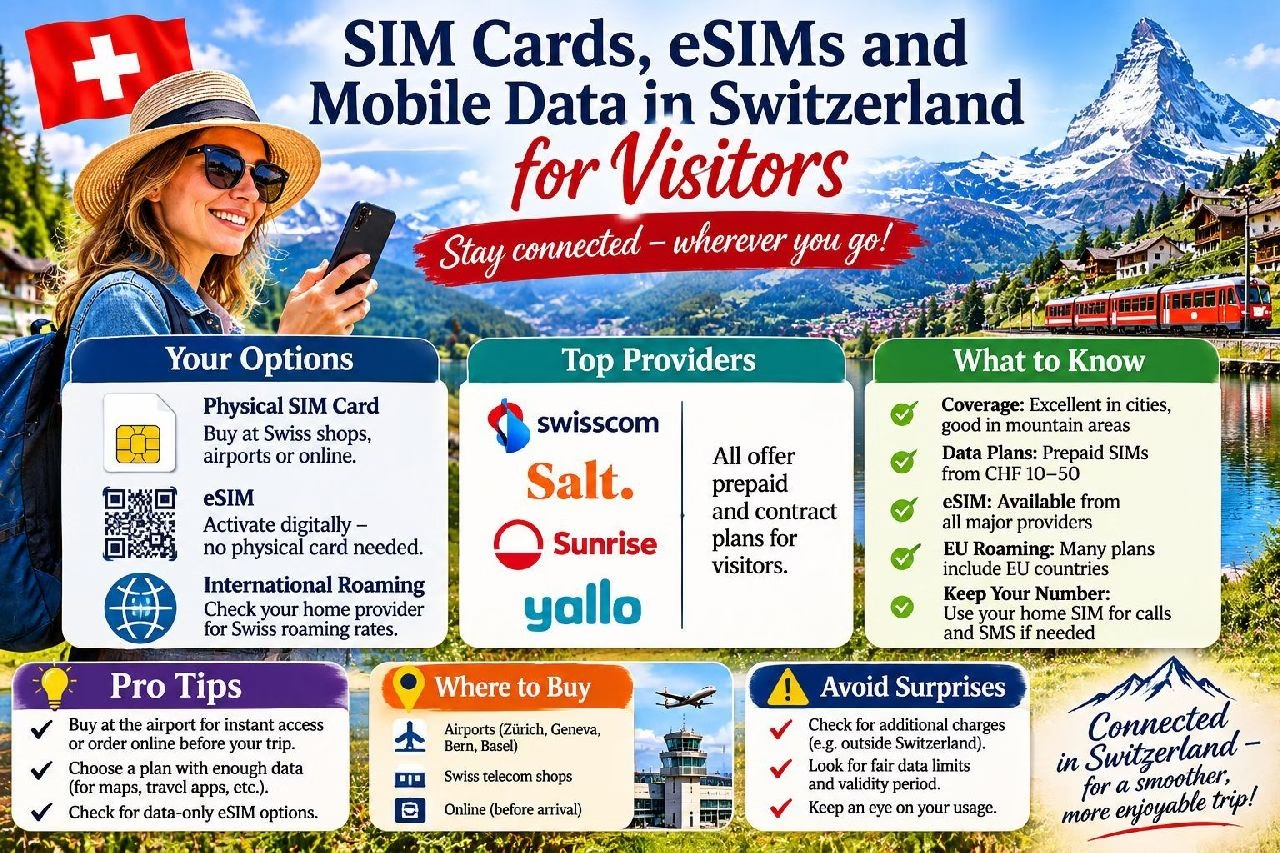
Switzerland is not part of the EU, so EU roaming rules do not automatically apply there. Check your plan before you travel, because costs differ between providers. Plans and prices change quickly, so compare current offers.
Staying connected in Switzerland is easy once you have a plan, but this is one of the places where an unchecked roaming bill can be a nasty surprise. Maps, train tickets and the weather forecast all depend on data, so it is worth deciding on your approach before you leave home. This guide explains the options, how to set up an eSIM or a local SIM, what to expect from coverage in the mountains, and how to avoid unexpected charges.
Your options
- Home roaming: simple, but ask your provider whether Switzerland is included and what the data limits are.
- Travel eSIM: an eSIM can be installed before arrival if your phone supports it and is unlocked.
- Local prepaid SIM: sold by Swiss operators and in shops. Registration with identification may be required, so bring your passport.
| Option | Best for | Watch out for |
|---|---|---|
| Home roaming | Very short trips, no setup | Charges that can be high, and data limits |
| Travel eSIM | Most visitors with a compatible phone | The phone must support eSIM and be unlocked |
| Local prepaid SIM | Longer stays, bigger data allowances | ID registration, and your home number may be out of reach |
| Wi-Fi only | Light use, tight budgets | No data on trains or trails, and security risks |
Roaming from your home plan
Some home plans include Switzerland in a roaming bundle, particularly from large operators in Europe and North America, but many do not. If yours does not, charges for calls and data can be high. Ask your provider whether Switzerland is covered, what the data allowance is, whether there is a daily fee and what happens when you reach the limit. If you plan to roam, set a data limit on your phone and turn off automatic updates and background app refresh.
Using a travel eSIM
An eSIM is a digital SIM that you install by scanning a QR code or using an app. It works alongside your normal SIM, so you can keep your home number for calls and text messages and use the eSIM for data. To use one:
- Check that your phone supports eSIM and that it is not locked to your home network.
- Buy and install the eSIM while you still have Wi-Fi, ideally before you leave.
- On arrival, switch your mobile data to the eSIM and turn off data roaming on your home SIM.
- Check whether the plan covers Switzerland specifically, since some eSIMs cover the EU but not Switzerland, and whether it is data only.
- Check the expiry rules, since many plans start counting from installation or first use.
Buying a local SIM
Switzerland has three main networks, Swisscom, Sunrise and Salt, plus several budget and supermarket brands that use these networks. Prepaid SIM cards are sold in operator shops, in supermarkets, at kiosks, at airports and at larger railway stations. Registration with photo identification is required, so bring your passport. Buy from an official shop or a well-known retailer, and avoid handing a copy of your passport to unofficial sellers.
A local SIM can offer a bigger allowance for the price and a Swiss number, which is useful for local services. The drawback is that you will not receive calls or texts to your home number unless your phone has a second SIM slot or eSIM. Keep your home SIM available if you rely on text messages for banking codes.
Coverage and Wi-Fi
Coverage is generally strong in towns and along main rail lines, but can be weak in remote valleys. Many hotels and cafes offer Wi-Fi. Download offline maps before hiking. See our mountain safety guide.
Swiss networks are fast and reliable in cities and villages, and many tunnels and mountain railways are covered, but gaps exist, especially in side valleys, on high trails and in mountain huts. Do not rely on a signal on a hike. Download offline maps and the route description, tell someone your plan and carry a charged phone and a power bank, since cold weather drains batteries quickly. In an emergency, 112 is the general emergency number, 144 calls an ambulance, and 1414 reaches the Swiss air rescue service for mountain emergencies. These numbers can usually be called even when your own network is not available.
Wi-Fi in hotels, cafes and stations
Most hotels and many cafes, restaurants and shopping centres offer free Wi-Fi, and airports and some main railway stations do too, though speeds and access rules vary. Some public networks ask you to register with a text message, which can fail on a foreign SIM, so do not rely on them for anything important. Use a VPN, or avoid sensitive logins on open networks.
Trains, tickets and apps
Timetables and tickets are often on your phone, so make sure your apps work before you leave a hotel with good Wi-Fi. Download or screenshot your tickets and passes in case your signal drops in a tunnel or valley. See our SBB train guide and our Swiss Travel Pass guide for how tickets and passes work.
Avoiding surprise charges
- Border areas: Near the border, your phone may connect to a network from the neighbouring country, such as around Lake Constance, Lake Geneva, Basel or Ticino, and this can trigger roaming charges. Choose your network manually or turn off data roaming in these areas.
- Trains and boats near borders: Cross-border trains and lake boats can also switch you to a foreign network.
- Background data: Turn off automatic updates, cloud backups and video autoplay when you roam.
- Calls and texts: Use Wi-Fi calling or a messaging app instead of standard calls, which can be costly abroad.
- Check usage: Look at your phone’s data usage and your provider’s app at the end of the first day.
Long stays
Remote workers and expats should look at monthly plans. See our expat and digital nomad guide and the practical information hub.
For a stay of a month or more, a prepaid or monthly no-contract plan is usually the simplest start. Contracts with Swiss operators often require a residence permit and a Swiss address, so they suit people who are settling rather than visiting. Some Swiss services and apps also ask for a Swiss phone number, so consider getting one if you will be here for a while. If you work remotely, check that your plan allows hotspot use, keep a backup connection and consider a coworking space for reliable internet.
Before you go: a checklist
- Check whether your phone is unlocked and supports eSIM.
- Ask your provider whether Switzerland is covered and what it costs.
- Download offline maps, tickets and any translation packs.
- Install your travel eSIM before you leave, or plan where you will buy a SIM.
- Keep your home SIM for banking codes and calls if you need them.
- Pack a power bank and a plug adapter. Switzerland uses its own plug type, which takes the standard two-pin plug but often not the earthed plugs used in Germany.
- Save emergency numbers on your phone.
SIM and mobile data FAQ
Does EU roaming work in Switzerland?
Not automatically. Switzerland is outside the EU roaming zone, so check with your provider whether it is included in your plan.
Is an eSIM better than a physical SIM?
For most visitors with a compatible phone, yes. It is quick to install and lets you keep your home number. A local SIM can offer more data for the price on longer stays.
Where can I buy a SIM card?
In operator shops, supermarkets, kiosks and at airports and main stations. Bring your passport for registration.
Will my phone work in the mountains?
Often yes, but coverage can be patchy in remote valleys and on high trails. Download offline maps and do not rely on a signal.
Is free Wi-Fi enough?
For light use it can be, but it will not help on trains, trails or between hotspots, and public networks carry security risks. Most visitors are better off with at least a small data plan.
Keep planning
You may also like our mountain safety guide, our SBB train guide, our expat and digital nomad guide and the practical information hub.

I’m Laura, a travel writer based in Zürich, and Switzerland is the place I know better than anywhere else. I moved here 9 years ago and haven’t stopped exploring it since.
Over the past 9 years I’ve made 40+ trips across every Swiss canton — from the Italian-speaking south of Ticino to the remote valleys of Graubünden to the lake towns of Romandy. I speak German, French and English fluently, which means I can read the local newspapers, argue with train conductors, and actually understand what the mountain guide is telling you when the weather turns.
Switzerland is a deceptively complex destination: four languages, 26 cantons, wildly different regional cultures, and a transport network so intricate it takes years to properly understand. I write to demystify all of it — whether you’re planning your first visit to Zermatt, deciding between Zürich and Geneva for a city break, or figuring out how to live here as a digital nomad or remote worker.
I also cover Central Europe for travellers who want to venture beyond the obvious — particularly the Czech Republic, Austria and the Alpine arc connecting Switzerland to its neighbours.
All About Swiss is my home base, where I publish in-depth guides to Swiss travel, life and culture. If it involves Switzerland, I’ve probably written about it, or I’m about to.