
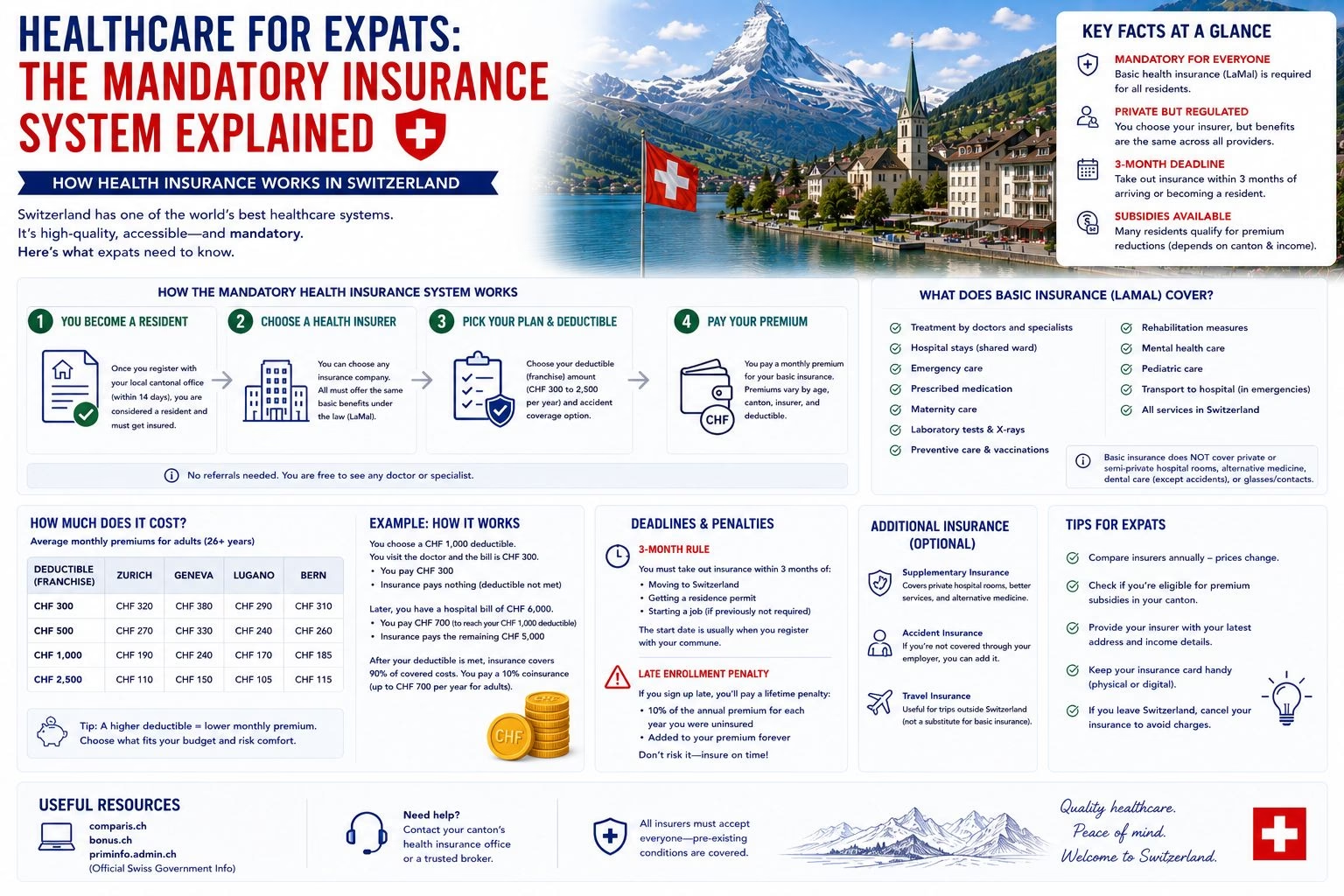
Switzerland’s healthcare system delivers genuinely high-quality care with short waiting times, but it runs on a mandatory private insurance model that’s structurally different from both the UK’s NHS-style system and most European public healthcare systems, and it catches many new residents off guard if they don’t plan for it in advance. Understanding the system before your three-month enrolment deadline arrives makes the whole process considerably less stressful than discovering the requirements after the fact.
The Core Requirement: Mandatory Basic Insurance
All Swiss residents, citizens and foreign nationals alike, are legally required to hold basic health insurance (Grundversicherung) within three months of establishing residence (or within three months of birth, for children born in Switzerland). This isn’t optional and isn’t provided by the state directly: it’s purchased from one of roughly 50 competing private insurance companies, all regulated by the federal Bundesamt für Gesundheit / Federal Office of Public Health (FOPH), which sets the mandatory coverage standards every basic policy must meet regardless of provider. There’s no opt-out for people who simply feel they don’t need it, and foreign private cover does not normally replace it. A few groups can apply for an exemption, for example if they already have equivalent cover through another country, so check with your canton’s insurance office if you think this applies to you.
Choosing an Insurer and a Model
Because all basic policies must cover the same mandatory benefits by law, the practical differences between insurers come down to premium price (which varies meaningfully insurer to insurer for identical coverage, making comparison genuinely worthwhile rather than a formality), customer service quality, and the specific model chosen. The deductible (Franchise) is the main lever available: choosing a higher annual deductible lowers the monthly premium in exchange for paying more out of pocket before coverage begins, and is a real trade-off worth thinking through based on expected healthcare usage rather than defaulting to the lowest or highest option automatically. A healthy young adult who rarely visits a doctor often does better financially with a higher deductible and lower premium, while someone with an ongoing condition or young children usually comes out ahead with a lower deductible.
Beyond the deductible, insurers also offer different care-access models, a standard model with free choice of doctor, or restricted models (HMO-style, or requiring a telemedicine consultation before a specialist referral) that lower the premium further in exchange for accepting some restriction on how you access care. These restricted models are worth considering for anyone comfortable with the trade-off, since the premium savings can be meaningful over a year.
Premium Reductions and Cantonal Variation
Premiums vary by canton, healthcare costs and therefore premiums differ meaningfully across Switzerland’s 26 cantons, sometimes by a large margin for otherwise identical coverage, and by age, with premiums generally rising through three broad age bands (children, young adults, and adults). Lower and middle-income residents may qualify for a cantonal premium reduction (Prämienverbilligung); eligibility is generally assessed after your first Swiss tax filing, so this is worth checking once that’s been completed rather than assuming it doesn’t apply, since the reduction can be substantial for qualifying households.
What Basic Insurance Doesn’t Cover
Basic insurance covers medically necessary treatment, hospital stays (in a shared ward, generally within your canton unless a referral requires otherwise), and prescription medication, but notably does not cover dental care, and only partially covers some other services like certain alternative therapies and vision care. Private supplementary insurance (Zusatzversicherung) is available separately for anyone wanting a private or semi-private hospital room, broader international coverage (relevant for anyone travelling frequently or planning to eventually leave Switzerland), dental coverage, or alternative medicine. This is genuinely optional and purchased on top of, not instead of, the mandatory basic policy, and is worth evaluating based on your own likely needs rather than purchased reflexively. Basic insurers must accept every applicant, but supplementary insurers can reject an application or add exclusions for pre-existing conditions, so arrange any supplementary cover before you need it.
Emergency Numbers
Switzerland’s emergency numbers are worth saving before you need them: 144 for medical emergencies and ambulance, 117 for police, 118 for fire, 1414 for the REGA air rescue service (particularly relevant for mountain or remote-area incidents), and 145 for the poison control centre. Basic insurance covers emergency treatment, though the usual deductible and 10 percent co-payment still apply, capped at CHF 700 per year for adults and CHF 350 for children.
Finding an English-Speaking Doctor
English-speaking doctors are common in Zürich, Geneva, and Basel, where many practices are used to international patients, and less common in smaller towns. The doctor directory doktor.ch lets you search by language, specialty, and location. Telemedicine services such as Medgate and Medi24 offer consultations in several languages, including English, which is useful for quick advice before you have found a regular doctor. Your insurer may also keep a list of affiliated doctors, which matters if you choose a restricted care model. Under the standard model you can usually see a specialist directly. Family doctor, HMO, and telemedicine models require you to go through your GP or a telemedicine service first, so check which model your policy uses.
Hospitals, Urgent Care, and Pharmacies
Most hospitals have an emergency department, and the larger ones are open around the clock. Walk-in urgent care clinics (Notfall in German, Urgences in French) can be quicker than a hospital emergency room for problems that are not life-threatening. For a true emergency, call 144 for an ambulance.
Pharmacies are called Apotheke in German, pharmacie in French, and farmacia in Italian, and every town has them. Outside normal hours, an on-call pharmacy (Notfallapotheke or pharmacie de garde) is always open nearby. Pharmacists are well trained and can advise on minor ailments, which can save a doctor’s visit. Prescription medication, including antibiotics, requires a prescription from a doctor.
Practical Steps for New Residents
- Register your address (Anmeldung) with your local municipality, this starts the three-month clock for mandatory insurance, and is covered in full in the Finding Accommodation guide
- Compare basic insurance quotes across several insurers rather than accepting the first offer, identical coverage, genuinely different prices, and comparison sites make this a fairly quick exercise
- Decide on a deductible level based on your expected healthcare usage, not automatically the cheapest option
- Enrol within three months of arrival, missing the deadline can result in backdated premium charges from your registration date rather than your enrolment date
- Check Prämienverbilligung eligibility after your first Swiss tax filing if your income is low or moderate
- Consider Zusatzversicherung separately if dental coverage or a private hospital room matters to you, and compare it independently from the basic policy since insurers price it differently
Related: Residence Permits | Cost of Living | Living in Zürich | Digital Nomad Guide
Written by Laura Meier. Updated regularly as prices and conditions change, corrections and updates welcome at contact@allaboutswiss.com.