
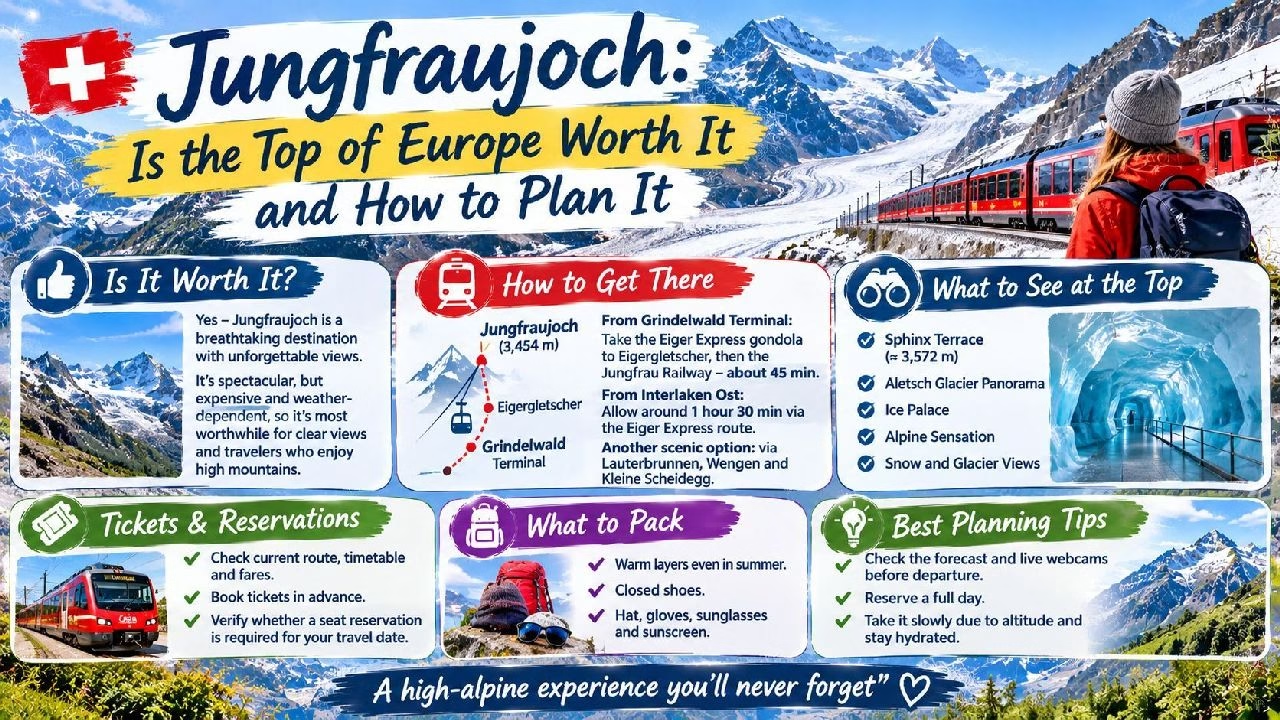
Jungfraujoch is a high-altitude saddle between the Mönch and Jungfrau peaks, reached by a cogwheel railway that runs partly through the mountain. It is one of the most visited excursions in Switzerland and one of the most expensive. Prices, schedules and conditions change, so check the operator’s current information before you book.
The station sits at about 3,454 metres, which makes it the highest railway station in Europe, and a viewing terrace on the Sphinx observatory rises higher still. Up here you can see the Aletsch Glacier, the longest in the Alps, a tunnel carved in glacial ice and, on a clear day, a vast sweep of peaks. It is also a place where weather, altitude and crowds can make or break the day. This guide explains whether it is worth the money, how the journey works, what to see once you arrive and how to plan around the conditions.
Is it worth it?
On a clear day the views of the Aletsch Glacier and the surrounding summits are exceptional. On a cloudy day you may see nothing, and the ticket is not cheap. Decide on the day, not weeks ahead, if your schedule allows it. If your budget is tight, the Schilthorn or a lower viewpoint can give better value. See our mountain excursions guide for alternatives.
A fair way to think about it is this. If you want a once-in-a-lifetime high-mountain experience with glaciers and snow in any season, and you are happy to spend a large part of a day on the trip, it is worth it in good weather. If you are mainly interested in hiking, flowers or quieter scenery, the same money and time spent on a ridge walk in the region may feel more rewarding. The summit is also busy, with large tour groups at peak times, so go with realistic expectations of a crowded, modern tourist complex rather than a remote wilderness.
How to get there
The route normally starts in Interlaken, continues to Lauterbrunnen or Grindelwald, and then changes to the mountain railway at Kleine Scheidegg. The whole journey takes a few hours each way. Many visitors go up one way and return another to see both valleys.
The usual route, step by step
- Interlaken Ost to the valley: A regional train takes you to Grindelwald or Lauterbrunnen in a short ride.
- Up to Kleine Scheidegg: A rack railway climbs from the valley station to the pass, with views of the Eiger, Mönch and Jungfrau.
- The final climb: From Kleine Scheidegg, the Jungfrau Railway runs through a tunnel in the Eiger and Mönch to the station at Jungfraujoch.
- The return: Come back the same way or switch valleys, and check the last departure from the top before you plan the afternoon.
A gondola line from Grindelwald to Eigergletscher can shorten the journey, so ask the operator which combination of train and cable car is currently offered and how it affects the price. A round trip from Interlaken typically takes most of a day, so allow plenty of time, and plan to be back in the valley before the last train. Some visitors choose to stay in Grindelwald, Wengen or Lauterbrunnen so they can start earlier and avoid the crowds.
| Choice | Good for | Keep in mind |
|---|---|---|
| Up and down the same valley | Simplicity and fewer changes | You see only one side |
| Up one valley, down the other | Seeing both valleys, a richer day | More changes, and check the last connections |
| Gondola on part of the way | Saving time | Fares and passes may differ, so check the details |
| Stay in the region the night before | An early start, better chance of clear views | Extra accommodation cost |
What to see at the top
- The Sphinx terrace: A lookout over the glacier and the surrounding peaks, reached by a fast lift. This is the main viewpoint and the place to be on a clear day.
- The Aletsch Glacier: The largest glacier in the Alps, flowing away from the saddle. It is part of a UNESCO World Heritage area.
- The Ice Palace: A series of tunnels and chambers carved into the glacier, with ice sculptures. It is cold and slippery underfoot, so wear shoes with grip.
- The snow plateau: A short outdoor walk across the snow, when conditions allow, with views and photo spots. Take it slowly at this altitude.
- Exhibitions and viewing windows: Displays about the building of the railway, and viewing points inside the mountain.
- Restaurants and shops: There are cafes, restaurants and shops at the top, but prices are high, so many visitors bring their own snacks.
Most visitors spend a few hours at the top. If the weather is clear, spend the first part outdoors on the terrace and the plateau, since clouds can build later in the day, and keep the indoor attractions for when the weather turns.
Planning tips
- Check live webcams and the forecast the evening before and again in the morning.
- Altitude is above 3,000 metres. Walk slowly, drink water and be aware that some people feel dizzy or breathless.
- Bring warm layers, sunglasses and sun protection, even in summer.
- Go early to avoid the busiest midday hours.
- Check whether your Swiss Travel Pass or Half Fare Card gives a discount. See the Swiss Travel Pass guide.
Weather and timing
The weather at the top can differ a lot from the weather in the valley. A grey, foggy morning in Interlaken does not always mean cloud at the summit, and a sunny valley can still have cloud on the peaks. That is why the live webcams at the top are more useful than a general forecast. Mornings are often clearer than afternoons, and operators sometimes offer cheaper early tickets, so ask about them if you are flexible. Because the ticket is expensive, build in a spare day if you are staying in the region, so you can wait for a good window. Our guide to mountain weather explains how to read the conditions.
Altitude and health
The train takes you very high very quickly, with little time to adjust, so some visitors feel the altitude. Common signs include a headache, dizziness, nausea, shortness of breath and unusual tiredness. To reduce the effect, move slowly, avoid heavy meals and alcohol, drink water and rest if you feel unwell. If symptoms are strong or get worse, go back down. People with heart or lung conditions, people who are pregnant and parents of young children should ask a doctor before they go. Do not push yourself on the snow plateau if you are short of breath.
What to wear and bring
- Warm layers, a windproof jacket, a hat and gloves. Temperatures at the top are often below freezing, even in summer, and the wind makes it feel colder.
- Sturdy shoes with good grip for snow and ice.
- Sunglasses and strong sun protection, since the glare from the snow and the thin air increase exposure.
- Water and snacks, and a card as well as a little cash.
- A charged phone, since cold drains batteries faster.
Tickets and passes
The excursion is one of the most expensive in Switzerland, and discounts depend on the pass you hold and the route you choose. Some passes give a reduced fare on the mountain railway rather than free travel, so check what applies to each section of the journey and whether you need to reserve. Compare the total with and without your pass before you buy, and look for any early-morning or off-peak fares. Our Swiss Travel Pass guide explains how passes work.
Cheaper or quieter alternatives
- Schilthorn: A cable car trip from the Lauterbrunnen valley to a summit restaurant with a wide view, usually cheaper than Jungfraujoch.
- Kleine Scheidegg and the Eiger views: You can reach the pass without going to the top and enjoy close views of the north face and easy walks.
- Lower viewpoints and hikes: Panorama trails and ridge walks in the region offer big views for little or no ticket cost. See our Jungfrau region hiking guide.
- Interlaken’s own viewpoints: Local lookouts above the town give a lake and mountain panorama at a much lower cost. See our Interlaken travel guide.
Jungfraujoch FAQ
How long does the trip take from Interlaken?
Allow most of a day. The journey takes a few hours each way, and you will want a few hours at the top, so an early start is best.
Is it worth going if it is cloudy?
Usually not for the views. Check the webcams, and if the summit is in cloud, consider waiting for a better day or choosing a different excursion.
Do I need to book in advance?
Not always, but it can help in peak season or if you want an early departure. Check the operator’s booking options, and keep flexibility for the weather.
Is it suitable for children?
Many families go, but the altitude and the cold can affect young children. Dress them warmly, keep the pace gentle and ask a doctor if you have concerns.
Can I use my Swiss Travel Pass?
Passes often give a discount on the mountain section rather than free travel. Check the current conditions before you buy.
Is it open all year?
The railway normally runs through the year, but severe weather can cause delays or closures, and some outdoor areas may be closed. Check the operator’s notices on the day.
Keep planning
Related: mountain weather, Jungfrau region hiking and the Interlaken travel guide. You may also like our mountain excursions guide and our Swiss Travel Pass guide.

I’m Laura, a travel writer based in Zürich, and Switzerland is the place I know better than anywhere else. I moved here 9 years ago and haven’t stopped exploring it since.
Over the past 9 years I’ve made 40+ trips across every Swiss canton — from the Italian-speaking south of Ticino to the remote valleys of Graubünden to the lake towns of Romandy. I speak German, French and English fluently, which means I can read the local newspapers, argue with train conductors, and actually understand what the mountain guide is telling you when the weather turns.
Switzerland is a deceptively complex destination: four languages, 26 cantons, wildly different regional cultures, and a transport network so intricate it takes years to properly understand. I write to demystify all of it — whether you’re planning your first visit to Zermatt, deciding between Zürich and Geneva for a city break, or figuring out how to live here as a digital nomad or remote worker.
I also cover Central Europe for travellers who want to venture beyond the obvious — particularly the Czech Republic, Austria and the Alpine arc connecting Switzerland to its neighbours.
All About Swiss is my home base, where I publish in-depth guides to Swiss travel, life and culture. If it involves Switzerland, I’ve probably written about it, or I’m about to.